Taking a Stand – reproductive rights in conflict with law

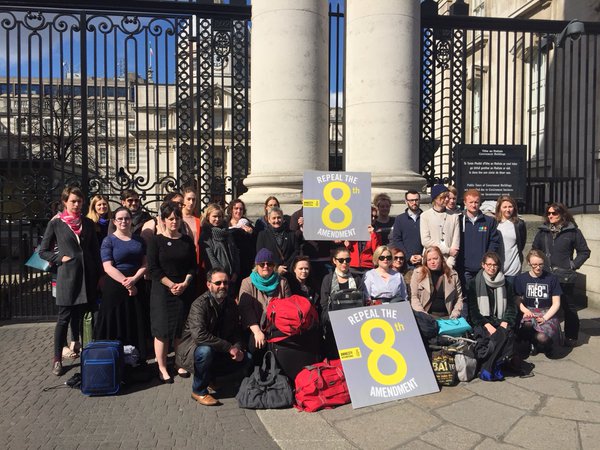
This afternoon I was fortunate enough to be in Dublin to attend the third day of Amnesty Ireland’s two-week campaign to repeal the Eighth Amendment. Each day for fourteen days they plan to have a presence on Merrion Street, outside Government Buildings; each day twelve more people will add to their numbers, to represent the twelve people forced, each day, to travel to the UK to access a legal abortion.

The simple force of this this protest is visible in the photos taken each day – three, so far – the numbers swelling and the corresponding pile of baggage getting higher. There is something deeply resonant in the action of placing oneself physically in a particular space to represent someone whose physical agency has been removed from them.

Discussion of physicality and embodiment are central to the work of gender and sexuality law. As much as current – and correct – thought trends toward removing the medical and physically-based definitions of queer identities (and I am using ‘queer’ in the sense of non-normative, challenging), the issue remains that the body is the site of conflict with the law when such conflict arises. The law meets these challenging identities in the regulation of gender identity and expression; the freedom to have sex, marry, form a family; and, in the instant case, the decision to regulate pregnancy status.

Asserting these freedoms brings the individual into contact with the regulatory power of the law, in their very corporeal existence. It is probably not the foremost thought in most people’s minds as they book a ferry ticket and try to think of an excuse for needing two days off work, but the conflict between the individual and the institutions of governmentality is playing out in their physical person as they do so.

Writing on transsexuality, Judith Butler interrogates our use of the phrase ‘doing justice to [someone]’. While her paper centres around gender identity regarding intersex children and non-consensual medical intervention, her critical examination of the space in which law and society allow individuals to exist is worth noting:

This is what Foucault describes as the politics of truth, a politics that pertains to those relations of power that circumscribe in advance what will and will not count as truth, that order the world in certain regular and regulatable ways, and that we come to accept as the given field of knowledge. We can understand the salience of this point when we begin to ask: What counts as a person? What counts as a coherent gender? What qualifies as a citizen? Whose world is legitimated as real? Subjectively, we ask: Who can I become in such a world where the meanings and limits of the subject are set out in advance for me? By what norms am I constrained as I begin to ask what I may become? What happens when I begin to become that for which there is no place in the given regime of truth? This is what Foucault describes as “the desubjugation of the subject in the play of… the politics of truth.”

Another way of putting this is the following: What, given the contemporary order of being, can I be?

When we interfere to the core of people in their most vulnerable moments, we are doing (in)justice unto them. The pregnant person does not get to decide if they wish to buy into the justice system of the state; they are merely the object of its dictats. They do not get to challenge the system in which they live; their survival needs render them extra-legal. Can one ever feel like a legitimate citizen when the regulatory power of the state has reached into the very blood and marrow of them and declared their physical needs non-normative and their mental wishes deviant?

But as noted, this is not the primary concern of the person in crisis, if indeed it is a concern at all. Into this space, then, step pro-choice activists. While it could be said that Irish women and AFAB people are always potential sites of conflict with reproductive rights law, not being currently in crisis offers the opportunity to stand in place of those who are.

Máiréad Enright wrote last year of the position of pro-choice activists in political discourse, using Rancière’s distinction between police and politics. She relates this to the importance of the presence of outsider voices and representation as a challenge to the status quo:

True politics, by contrast, is about upsetting the dominant distribution of the sensible. Politics takes place when in moments of dissent “the part of no part” – those who normally should not be seen or heard – intervene in the established system of meanings, questioning it, and by that questioning insisting on their equality with others as political subjects and members of a broader “we”. For example, at this year’s March for Choice, the comedian Tara Flynn spoke movingly about Ireland’s abortion regime. In a lighter moment, she noted that reproductive rights campaigns were often construed in the public sphere as a ‘women-y fringe-y thing”. But, she said, of the assembled pro-choice marchers, “we are not some women-y fringe-y part of society, we are society”.

We are society. We are political, we are visible, and we are choosing to use our physical autonomy in the defence of those who are denied theirs. Creating this community, this space wherein we act to queer the strictures of the Irish legal system’s understanding of gender roles, resonates far beyond the hour spent at Government Buildings. It is a rebellion, a deliberate step into transgressive territory. When physical oppression is enacted, physical challenge is the only freedom left us. We’re using it.

I’ll be back on Merrion Street next week. Amnesty will be there all this week and next. Twelve people a day, tomorrow and tomorrow and tomorrow. Be their advocate. Sign up here, particularly for the latter days when 100+ people will be required: https://www.amnesty.ie/news/demonstration-outside-government-buildings-show-abortion-cannot-be-ignored-government-formation
ce4gl-kwiaevs9i
Image from @AmnestyIreland twitter (I am third from left).

Gender Identity at the United Nations

My most recent research project has involved compiling a report on gender identity and gender recognition in the Reports, Comments, and Concluding Observations of the United Nations Treaty Bodies and Special Procedures. The findings have had mixed success: in recent years the UN bodies have been more receptive to matters concerning sexual orientation and gender identity issues; however, explicit reference to gender recognition law or gender identity as distinct from the catch-all title of ‘LGBT persons’ are still uncommon.

My research uses the term ‘gender-variant/variance’ to address all non-cisgender persons, including under this remit transgender, transsexual, non-binary, and intersex persons. In doing so I also hope to avoid the imposition of Western terms on persons from cultures which do not have a direct equivalent of our ‘transgender’. Finally, in some countries – such as India, one of the jurisdictions I will be researching for my thesis – there is no clear boundary between sexual orientation and gender identity as it is widely considered that homosexual acts or desires constitute in themselves a form of gender variance. In a project which seeks to challenge the normative functions of legal gender, avoidance of over-categorisation is important.

In legal scholarship, gender identity is often mentioned in the same breath as sexual orientation, despite presenting some very different challenges to the law of human rights; this report acknowledges instances in which a general ‘gender and sexuality minorities’ category is used, while attempting to draw forward true instances of consideration of gender identity and gender expression issues. Instances in which the institutions acknowledge queer and intersex identities are highlighted as marks of progress in inclusion – however, in many cases they are omitted within the reports and observations emerging from the UN.

As McGill’s history of sexual orientation and gender identity before the UN ([2014] 3 Can. J. Hum. Rts. 1) shows, the first time gender identity was explicitly mentioned in UN proceedings was in 2006, with the Joint Statement on Human Rights Violations based on Sexual Orientation and Gender Identity before the Human Rights Council. The General Assembly followed in 2008 with the adoption by the UN General Assembly of the Statement on Human Rights, Sexual Orientation and Gender Identity. This resolution, while non-binding, marked the first acknowledgement by the General Assembly of the human rights of sexuality- and gender-based minorities.

2008 is also the point of departure for many of the UN institutions in acknowledging gender identity as a factor in discrimination and persecution of minorities and individuals. The adoption of the General Assembly resolution, along with the signing of the (non-UN, but influential) Yogyakarta Principles in 2007, brought both sexual orientation and gender identity to the fore and led to attention from both States Parties and Treaty Bodies/Special Procedures. In the years between 2008 and 2016, the jurisprudence of the Treaty Bodies has seen a continuing upward trend in references to LGBT/SOGI issues. However, transgender and gender-variant persons, as well as intersex persons, are still often sidelined by the institutions, which in many cases tend to consider as analogous homophobic discrimination and SOGI-based discrimination.

The opinions of Treaty Bodies and Special Procedures recorded in my report are not entirely based in legislative proposals – although some are made – but rather, they show the frequency of discrimination and persecution that occurs when transgender persons are marginalised and illegitimised. As an argument for the importance of gender recognition law, therefore, they show the necessity of decriminalising, addressing, and including gender-diverse identities into the scheme of international human rights law.

The Committees which engage the most with gender identity issues are the Human Rights Committee (HRC), the Committee on Economic, Social, and Cultural Rights (CESCR), and the Committee on the Elimination of Discrimination Against Women (CEDAW). These are not surprising findings – where international law meets gender variance, in the main, involves legal recognition (a civil/political right); access to healthcare (a socioeconomic right); and discrimination on the basis of gender. While it is true that almost all gender-variant individuals will encounter discrimination on the basis of their gender identity/expression in some situations, CEDAW concerns itself greatly with the dangers of sexual and other violence suffered by transgender women who are often attacked in situations like enforced confinement in men’s prisons.

General Comment 22 of the CESCR, on the right to sexual and reproductive health and published earlier this month, explicitly recognises the need for recognition of gender-variant persons, stating:

For the purpose of this General Comment, references to LGBTI persons include, in addition to lesbian, gay, bisexual, transgender and intersex persons, other persons who face violations of their rights on the basis of their actual or perceived sexual orientation, gender identity and sex characteristics, including those who may identify with other terms.

This is the most explicit statement of recognition and personhood of all queer and gender-variant identities to be found in the UN’s collective output on the subject so far. The addition of intersex to the protected designation ‘LGBT’ shows a willingness to promote the welfare of those with non-standard sexual characteristics, who may identify within the binary or otherwise. It is to be hoped that the UN will continue to include a broader range of physical and personal identities in their statements, and in contexts other than healthcare. While it is undeniable that healthcare is an area which disproportionately engages gender-variant persons, addressing these persons mainly through the lens of healthcare does continue to associate gender variance with pathologisation. A statement on the civil/political right of such persons to legal gender recognition would be welcome.

The countries most targeted for recommendations by the UN Committees are the Russian Federation, Ukraine, and Kyrgyzstan, all of which operate restrictive laws around freedom of expression and assembly of queer and gender-variant persons (“propaganda laws”). The Committees find it concerning that these laws, ostensibly for the protection of children from immoral factors, are used instead to stigmatise and criminalise queer and gender-variant persons who attempt to speak or associate freely. Ukraine also comes under heavy criticism (CCPR/C/UKR/CO/7, paragraph 10) for its treatment of persons seeking medical help in gender transition as psychiatric patients with a compulsory confinement to a psychiatric hospital for up to 45 days, as well as mandatory surgery. The Committees also remark on the criminalisation of transgender identities in the Gulf states such as Iran and Kuwait.

With regard to the Special Procedures, the Rapporteurs who concern themselves most with gender and sexuality-based minorities are the Special Rapporteurs on Health, on Human Rights Defenders, on Violence Against Women, and on Extrajudicial, Arbitrary, or Summary Executions. The latter two are the unfortunate consequence of the violence suffered by many gender-variant persons, particularly transgender women or female-presenting persons – in particular in Guatemala, Mexico, and Turkey.

The Special Rapporteur on Human Rights Defenders has been a consistent voice against the adversity experienced by defenders working with gender- and sexuality-based minorities since 2002 (E/CN.4/2002/106/Add.2 – the earliest statement on ‘LGBT’ persons I located in the UN reports). The mandate’s reports have been consistent in addressing ‘sexual orientation and gender identity’ or ‘LGBTI’ issues in the intervening years. This attention illustrates the difficulties of working for causes such as gender recognition, which face cultural barriers in many parts of the world.

The Special Rapporteur on Health has, unsurprisingly, been one of the main promoters of the rights of gender- and sexuality-based minorities, beginning in 2004 (E/CN.4/2004/49) with a statement on discrimination against “many people with lesbian, gay, bisexual and transgender identities or conduct” – quite a progressive statement, including gender expression (“conduct”) as well as identity. The mandate has also stated its opposition to medical intervention on children born intersex, on the basis of bodily autonomy. Its statement regarding intersex persons in childhood development (A/70/213) also included recognition that

Deeply rooted stereotypes around gender dichotomy and medical norms about male and female bodies have led to the establishment of a medical practice of routine interventions and surgeries on intersex people, including irreversible genital surgery and sterilization.

This strong statement on bodily autonomy and sex characteristics shows a willingness to engage with the most sidelined minorities in this area, and is a promising development for UN output and practice.

While much of the UN’s engagement with gender identity issues is not strictly based on the kind of legal recognition which is the basis of my research thesis, the knowledge base gained from seeing how international human rights institutions engage with gender-variant identities and expressions allows for a better understanding of the norms, cultural and regulatory, involved in human rights law in this area. As my research involves consideration of how domestic legal systems tackle issues around gender recognition, it necessarily requires a basis in the dominant discourse of international human rights law. I will continue to survey these institutions in the next stage of my research, exploring gender identity and recognition before the regional human rights systems (in particular, the European and Inter-American Courts of Human Rights).