Bell v Tavistock overturned on appeal

This is a quick post for non-law audiences to explain what happened in the appeal of Bell v Tavistock at the Court of Appeal on 17th September.

I previously covered the original judgment in Bell here.

To summarise the original judgment: it was held that “it is highly unlikely that a child aged 13 or under would ever be Gillick competent to give consent to being treated with [puberty blockers]… In respect of children aged 14 and 15, we are also very doubtful that a child of this age could understand the long-term risks and consequences of treatment in such a way as to have sufficient understanding to give consent.” (Bell 1, at 145)

Gillick competence is the main legal issue at stake in these cases. It arises from a 1986 case where a mother wanted to stop her teenage daughter from accessing contraception. The Court in Gillick held that the girl could consent to be prescribed contraception “if she had sufficient maturity and intelligence to understand that nature and implications of the proposed treatment.” (Gillick, 105). Gillick competence applies to many aspects of medical care, including topical issues like abortion access and vaccine consent.

What the Divisional Court held in their declaration in Bell 1, then, was that a children under 16 would most likely not be able to understand the nature and implications of being prescribed puberty blockers, for a number of reasons. Prominent among the reasons was the correlation that the Court drew between use of puberty blockers (which are reversible) and later adult use of cross-sex hormones such as oestrogen or testosterone. The Court believed that children were entering on a path that they could not fully comprehend. This was the outcome desired by the applicant, Keira Bell, who believes that she did not have capacity to consent to transition-related healthcare as an adolescent (it is very important to note, however, that Bell did not have any irreversible medical interventions, such as her mastectomy, until she reached adulthood – thereby rendering her complaint somewhat hypothetical.)

The Court of Appeal in Bell 2 disagreed entirely with the Divisional Court’s conclusions. It found that the Divisional Court had identified that the Tavistock had not done anything unlawful, but continued to issue its declaration and guidance instead of dismissing the case. The Court of Appeal seemed surprised by this, and went on to enumerate the ways in which it disagreed with the lower Court.

It disagreed firstly with the way the Divisional Court had handled the evidence which was submitted to it, much of which was controversial in nature and “argumentative and adversarial” in a way that did not comply with the rules of evidence (Bell 2, 38). It looked at the evidence and found that puberty blockers were safe, tested, and separate to later hormonal treatments (Bell 2, 24-25). The Court of Appeal then went on to point out the many flaws it found in the judgment in Bell 1, in the Divisional Court’s handling of the legal precedent and the factual findings, and in the decision to issue the declaration and guidance quoted above (Bell 2, many paragraphs, 61 onward). They found the series of decisions made by the lower Court to be faulty and based on unsound footings.

Most importantly, the Court of Appeal affirmed that Gillick competence applies to decisions around puberty blockers. As they stated, “Nothing about the nature or implications of the treatment with puberty blockers allows for a real distinction to be made between the consideration of contraception in Gillick and of puberty blockers in this case…” (Bell 2, 76). Unlike in Bell 1, puberty blockers were not seen to be a special case or a particularly controversial subject. Gillick applies to them just as much as to any medical decision. The Court of Appeal went on to reaffirm the role of clinicians in making judgements around the prescription of blockers (Bell 2, 92) – and indeed, in all medical decisions – but found that it was for doctors, not the Courts, to make those calls.

What does this mean in practice? It means that young trans people under 16 can be judged capable to give their own consent to the prescription of puberty blockers, provided they fulfil Gillick criteria and fully understand the nature and implications of the treatment. It means that the Tavistock can go back to referring trans children to endocrinologists for puberty blocking treatment without needing court orders to do so. It means that young trans people are judged to be as competent as any other young person when it comes to making medical decisions about their bodies.

What now? Bell and her legal team have stated their intentions to appeal to the Supreme Court. However, in my legal opinion, it seems unlikely that there is a significant enough point of law identifiable for debate in the Court of Appeal judgment for the Supreme Court to agree to hear the case – a hearing in the Supreme Court is not guaranteed just because one of the parties seeks it.

It looks likely that this is the last the Courts will hear of the case Bell v Tavistock in and of itself, but its influence may continue to be felt. Arguments such as those made in the original submissions to the Divisional Court have been seen around abortion access and Covid-19 vaccines. Young trans people have seen their access to medication halted, in some cases for many months – which is time they will not get back, and during which they may have undergone some distressing physical changes. Gillick stands, and applies to trans persons as much as to cis persons, but its universality has been shaken by the way in which it was misapplied by the Divisional Court. It is now seen as open for attack by persons who might seek to try to limit its use much as the applicants did in Bell 1.

Forstater v CGD – the judgment in brief

With today’s beginning of the appeal of Forstater v Centre for Global Development, a certain amount of misinformation has been floating around the social media and blogsphere. This post highlights the pertinent facts of the original 2019 judgment. Quotes are taken from the judgment; numbers in brackets are paragraphs.

Summary: Forstater was not fired for her beliefs. She came to the end of her contract and it was not renewed, after colleagues had reported her repeated tweets as transphobic. The Court analysed the nature of a ‘belief’ as a protected characteristic under the Equality Act 2010 with regard to the criteria expressed in Grainger (2010). It found that Forstater’s beliefs failed the Grainger test under its fifth prong: “it must be worthy of respect in a democratic society, not be incompatible with human dignity and not conflict with the fundamental rights of others.” This is because her beliefs did not respect the dignity and human rights of trans persons, and that her repeated and firm statements of them created an “intimidating, hostile, degrading, humiliating, or offensive” workplace environment for trans persons.

Maya Forstater is an adherent of a philosophy which terms itself ‘gender-critical feminism.’ This philosophy includes the belief that “sex is immutable,whatever a person’s stated gender identity or gender expression.” (3) Forstater claimed that her beliefs should be protected under the Equality Act 2010 and that she had been discriminated against because of them, or because of her sex (as those beliefs are allegedly more likely to be held by women).

Forstater, who described herself as a “researcher and writer on topics related to public policy, tax and business, with an active social media presence” (21), was a consultant with the CGD at various periods on temporary contracts or time-limited Fellowship between 2015 and 2018. During this time, she developed “concern[s] about proposed changes to the Gender Recognition Act 2004” (23) and began tweeting about them. She also made statements like “if people find the basic biological truths that “women are adult human females” or “transwomen are male” offensive, then they will be offended. Of course in social situations I would treat any transwomen as an honourary female, and use whatever pronouns etc… I wouldn’t try to hurt anyone’s feelings but I don’t think people should be compelled to play along with literal delusions like “transwomen are women.” (27)

Some of Forstater’s colleagues raised an alarm about these statements in October 2018, calling them transphobic. She denied this allegation (29) stating “I have been told that it is offensive to say “transwomen are men” or that women means “adult human female”. However since these statement are true I will continue to say them… I would of course respect anyone’s self-definition of their gender identity in any social and professional context; I have no desire or intention to be rude to people.” (31)

Many other tweets which contained similar sentiments were also adduced as evidence to back up the assertion that these are “core aspects of [her] belief.” (40) Her evidence in Court contained similar sentiments also.

Forstater’s contract with the CGD was not renewed after 2018, but she contends that she was an applicant for employment with them again, and thereby protected by the Equality Act 2010, when she made her complaint to the Employment Tribunal in early 2019.

Belief is a protected characteristic under the Equality Act 2010. The 2010 Act defines it as “any religious or philosophical belief” and further states that “Belief is to be interpreted in a human rights context.” (47) The Court went on to state that:

To qualify as a “philosophical belief” under section 10 EqA, the belief must satisfy the five criteria in Grainger plc v Nicholson [2010] ICR 360, para 24 (“the Granger Criteria”):

(i) the belief must be genuinely held;

(ii) it must be a belief and not an opinion or viewpoint based on the present state of information available;

(iii) it must be a belief as to a weighty and substantial aspect of human life and behaviour;

(iv) it must attain a certain level of cogency, seriousness, cohesion and importance; and

(v) it must be worthy of respect in a democratic society, not be incompatible with human dignity and not conflict with the fundamental rights of others. (50)

Because ‘lack of belief’ is also a protected characteristic under the Equality Act, Forstater argued that the “gender identity belief” she lacked was to be protected. (56)

In its analysis, the Court stated that “Having protected characteristics, including philosophical beliefs,does not prevent people from having to take care not to harass others.That being said, full regard must also be given to the qualified convention right of freedom of expression.” (75) It went on to consider Forstater’s belief in both its terms, its importance to her, and its fixity in her mind. The analysis included the assessment that “I do not consider that the Claimant’s belief fails the test of being “attain a certain level of cogency, seriousness, cohesion and importance”; even though there is significant scientific evidence that it is wrong.” (83)

Coming to the heart of its analysis, the Court stated that:

However, I consider that the Claimant’s view, in its absolutist nature, is incompatible with human dignity and fundamental rights of others. She goes so far as to deny the right of a person with a Gender Recognition Certificate to be the sex to which they have transitioned. I do not accept the Claimant’s contention that the Gender Recognition Act produces a mere legal fiction. It provides a right, based on the assessment of the various interrelated convention rights, for a person to transition, in certain circumstances, and thereafter to be treated for all purposes as the being of the sex to which they have transitioned… (84)

…The Claimant does not accept that she should avoid the enormous pain that can be caused by misgendering a persons, even if that person has a Gender Recognition Certificate. In her statement she says of people with Gender Recognition Certificates “In many cases people can identify a person’s sex on sight, or they may have known the person before transition…. There is no general legal compulsion for people not to believe their own eyes or to forget, or pretend to forget, what they already know, or which is already in the public domain.” The Claimant’s position is that even if a trans woman has a Gender Recognition Certificate, she cannot honestly describe herself as a woman. That belief is not worthy of respect in a democratic society. It is incompatible with the human rights of others that have been identified and defined by the ECHR and put into effect through the Gender Recognition Act… (85)

…Calling a trans woman a man is likely to be profoundly distressing. It may be unlawful harassment. Even paying due regard to the qualified right to freedom of expression, people cannot expect to be protected if their core belief involves violating others’ dignity and/or creating an intimidating, hostile, degrading, humiliating or offensive environmentfor them… (87)

…I draw a distinction between belief and separate action based on the belief that may constitute harassment. However, if part of the belief necessarily will result in the violation of the dignity of others, that is a component of the belief,rather than something separate, and will be relevant to determining whether the belief is a protected philosophical belief. While the Claimant will as a matter of courtesy use preferred pronouns, she will not as part of her belief ever accept that a trans woman is a woman or a trans man a man, however hurtful it is to others… (88)

…I conclude from this, and the totality of the evidence,that the Claimant is absolutist in her view of sex and it is a core component of her belief that she will refer to a person by the sex she considered appropriate even if it violates their dignity and/or creates an intimidating, hostile, degrading, humiliating or offensive environment. The approach is not worthy of respect in a democratic society. (90)

reflections on trans narratives and the law

Too often, trans people’s lives disappear into a morass of medical and legal arguments. Too often, we fail to see the person behind the arguments; the lives behind the debate.

I am writing an academic article about narratability, about the capacity to tell one’s story, and the relationship between that and human rights; the accessibility and reality of rights for trans people. I have returned to this post again and again. It remains difficult to write.

Here is the issue: there is a large lobby of people in this country who wish trans people did not exist. There is a large lobby of people in this country who would rather children were suicidal than that they were trans, or that they were helped. These people have a platform that we do not. I am writing on this blog; they are writing in the newspapers.

In the past few weeks, the courts here in the UK have decided that children under 16 are very unlikely to be able to consent to puberty blocking hormonal treatment. Puberty blockers are a safe, reversible treatment which are used to delay the onset of pubertal developments which are incongruous with the child’s gender identity. They are recognised worldwide as a useful – indeed, often necessary – intervention for trans children. But the decision of the High Court has meant that it is now highly unlikely that children will be able to access this treatment. It is hard to convey the devastation this is causing for the children affected, and for their families. Overnight, their access to the healthcare that is allowing them to cope with growing up in a world where their interactions with society are shaped by an incongruity between their self-image and society’s perception, has been taken away. Overnight, their safety-net has been ripped from underneath them.

I don’t intend, in this post, to go into the academic or legal aspects of the judgment. I’ve already done that in another post. I want to highlight the human.

Here’s the thing. Trans people should have the right to their stories. Their own stories, of their own lives, lived how they choose. But the restrictions that a cisnormative society – a society that privileges cisgender identity – places them under mean that frequently, they must sacrifice that right in order to be understood by institutions like doctors and courts. The children affected by the Bell ruling have already had to explain themselves over and over to doctors. Now they will have to do the same thing to a judge, before they can access their medications.

Cisnormative institutions understand a particular kind of story. They understand one where trans identity is pathologised – where it is a medical process. They understand the narrative of transition as a definable journey from a point A on a binary scale to a point B on the opposite side. They understand stories where gender identity is fixed and does not fluctuate. We can see this in the terms set out in the Gender Recognition Act 2004 – its insistence that you must choose a gender identity to live in until the end of your life; its requirement of a two-year ‘real life test’ before legal gender recognition can be approved.

But this is not reality. In reality, gender identity is messy and nuanced and fluid, and glorious in its indefinability. People’s identity changes over the course of their life. They identify inside or outside the binary. They transgress gender norms and categories and live in the liminal spaces. Law and medicine do not understand this because of what they are, because they are creatures of rules and norms.

I am writing about how, when applicants came to the European Court of Human Rights to petition for the UK to legislate for legal gender recognition, their stories were taken from this beautiful humanity and distilled down to narratives of surgery, effort, and pain. Before the law would hear them, they had to have gone through medical and surgical interventions. Before they could access those, they had to lay open their lives to doctors. Their transition journeys, as mediated through the lens of medical science, had to be literally written on their bodies in pain before the Court of Human Rights would hear their applications. This does not feel like human rights.

I am struck by the absence of trans people in the reporting around the Bell decision. I am struck by watching three experts in trans and gender law – all trans – defending their lives and experiences to the Women and Equalities Committee of Parliament, and being countered by three non-experts whose qualifications seem to be mainly being academics with opinions.

I want us to do more than hashtag #TransRightsAreHumanRights. They are, of course, and as a human rights lawyer I will defend that to the last. But we seem to be losing the human. I am writing about stories, and I am trying to highlight the loss of stories – because if we do not hear people, really hear them, we cannot possibly hope to share in any constructive actions toward making the world a better place for them to live in.

If society cannot hear who trans people are without making them commit to definitions of gender invented by cisgender doctors; without making them undergo physical transformations so that they conform to cisgender standards of bodily presentation; without having them explain their lives to cisgender judges to gain approval under cisnormative laws; then society as a whole is failing them.

I am writing about stories, and rights, and where they intersect. I am writing for a future where I do not have to do this work. I will listen to the stories that that future will tell.

Bell v Tavistock NHS Trust – a quick reaction post

Today the High Court handed down its judgment in the case of Bell v Tavistock NHS Trust, which case concerned a judicial review of the practice of the Tavistock Gender Identity Development Service in prescribing puberty-blocking medical treatments to persons under the age of 18.

Puberty blockers are hormonal medicine which delay the onset of normal puberty and stop the development of physical pubertal indicators. They are used for trans children, to spare them having to grow up in a body which does not match their gender identity, and cis children who undergo precocious puberty. Puberty blockers can be a lifesaving treatment for young persons who have suicidal ideation as a result of their changing bodies. Their effects on puberty indicators are completely reversible, however some questions around their effects on other physical factors like bone density and fertility are still under investigation.

Puberty blockers are often prescribed to children who receive a diagnosis of gender dysphoria from services like Tavistock GIDS. In many cases, those children go on to undertake further medical interventions such as hormonal treatments (CSH) as adults – however, it is exceedingly important to note that this is not inevitable.

The complainant in this case identified as a trans boy as a teenager and into young adulthood, although as an adult she now identifies as a woman. She claims that “I made a brash decision [in transitioning] as a teenager, (as a lot of teenagers do) trying to find confidence and happiness, except now the rest of my life will be negatively affected. I cannot reverse any of the physical, mental or legal changes that I went through.” (83) She does not believe that she was competent to make those decisions as a minor (however, again, it is to be noted that the irreversible parts of her transition, such as her mastectomy, took place as an adult – minors do not receive gender-related surgery in the UK).

Minors are held to be competent to make medical decisions if they fulfil what is known as Gillick competence. This arises from the case of Gillick v West Norfolk and Wisbech Area Health Authority (1986), in which a 16-year-old girl wanted to access contraception. The Court held that she could validly consent to the treatment “if she had sufficient maturity and intelligence to understand that nature and implications of the proposed treatment.” (105) Gillick competence has been used for trans children accessing gender-affirming treatment.

However, the Court in Bell has restricted Gillick competence in the case of under-16s. Although the principle still applies, they state that “The conclusion we have reached is that it is highly unlikely that a child aged 13 or under would ever be Gillick competent to give consent to being treated with [puberty blockers]… In respect of children aged 14 and 15, we are also very doubtful that a child of this age could understand the long-term risks and consequences of treatment in such a way as to have sufficient understanding to give consent.”

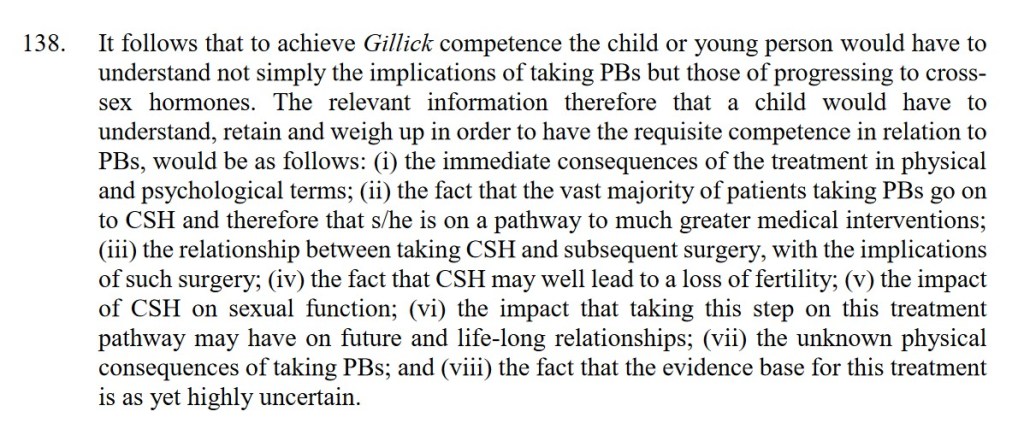
The list of factors that the Court believes a young person needs to understand in order to be Gillick competent are as follows:

It is not impossible that a teenager would be able to answer to this list. However, it would be difficult to prove.

The Court’s reasoning includes the following excerpt:

“First, the clinical interventions involve significant, long-term and, in part, potentially irreversible long-term physical, and psychological consequences for young persons. The treatment involved is truly life changing, going as it does to the very heart of an individual’s identity. Secondly, at present, it is right to call the treatment experimental or innovative in the sense that there are currently limited studies/evidence of the efficacy or long-term effects of the treatment. (148)

… In principle, a young person’s autonomy should be protected and supported; however, it is the role of the court to protect children, and particularly a vulnerable child’s best interests. The decisions in respect of PBs have lifelong and life-changing consequences for the children. Apart perhaps from life-saving treatment, there will be no more profound medical decisions for children than whether to start on this treatment pathway. In those circumstances we consider that it is appropriate that the court should determine whether it is in the child’s best interests to take PBs. There is a real benefit in the court, almost certainly with a child’s guardian appointed, having oversight over the decision… As we have explained above, we consider this treatment to be one where the protective role of the court is appropriate… (149)

The problem is not the information given, but the ability of the children and young people, to understand and most importantly weigh up that information. The approach of the defendant appears to have been to work on the assumption that if they give enough information and discuss it sufficiently often with the children, they will be able to achieve Gillick competency. As we have explained above, we do not think that this assumption is correct.” (150)

There are likely to be a number of effects arising from this decision. In this section, I am expressing my own opinions.

Firstly, it is likely to cause a significant chilling effect on the prescription of gender-affirming hormonal treatments to persons under 16. The Court appears to use a reasonable-person standard that it is holding high above the heads of children (whether or not, in real life, they could meet it). With this, it will be harder for a child to be declared Gillick competent to receive puberty blockers. The “protective” role of the Courts is also a concern. Will court orders be required in the provision of puberty blockers to young trans people? This would cause significant delays in treatment and could potentially have deleterious effects on the mental health of the young people in question, both from the delay and the general difficulties of going through the scrutiny and stress of the court process.

(Edit, 9pm, December 1st: it is being reported that the GIDS is already contacting families of trans young people and cancelling their appointments.)

Even for a decision regarding medical treatments, this is a particularly pathologised piece of jurisprudence. This blog post has tried to be trans-affirming in its expressions; however, in that, it does not follow the judgment itself. Transgender identity is referred to as ‘gender dysphoria’ all through, with the emphasis on its diagnosis as a psychological condition that people “suffer from.” There is no affirmation of the identities of these young people and no rights-based language. Transition is presented as a negative process which should almost be avoided if possible, rather than a series of interventions, many reversible, which can improve the lives of the people in question.

With regard to the correlation between children who take puberty blockers and adults who go on to take hormonal interventions, the Court seems to take the high correlation rate as an indicator that such advancement is inevitable, even including the effects of “CSH” on sexual function (etc) in their conditions for Gillick competence. This seems erroneous. Correlation is not destiny. Puberty blockers are reversible. Adult hormonal treatments are not inevitable. It does not seem entirely justifiable to say that one MUST understand the effects of adult hormonal treatments at age 13 when one must be at least 16 to make the informed choice as to whether to begin those treatments.

Lastly, and most concerningly, this case may have ripple effects for other questions of the bodily autonomy of minors. What happens now to a 14-year-old presenting needing an abortion? Is she to be taken to understand the “lifelong consequences” of her decision, or is the standard for Gillick competence to be raised on her too? If so, there is a human rights violation in the waiting for minors needing reproductive healthcare and it seems inevitable that this will end up before the Courts.

Dr Sandra Duffy holds a PhD in international human rights law, focusing on gender identities and gender recognition law. She is co-author of the ILGA Trans Legal Mapping Report, which catalogues global gender recognition laws.

The Gender Recognition Act 2015: A Long Time Coming

Although the Irish Gender Recognition Act 2015 was signed into law in 2015, it was by no means a new idea by then. With the Lydia Foy judgments in 2002 and 2007, commitments in Programmes for Government starting in 2009, and parliamentary processes including public consultations stretching over four years, the GRA was a lengthy and highly debated process which would eventually leave Ireland with an internationally renowned, human rights-compliant legislation.

There has been a myth circulating of late that the Gender Recognition Act was ‘snuck in’ or somehow secretly passed without the proper legislative scrutiny. The background to this is a mistaken belief that the Act was brought in on the back of marriage equality in May 2015 and therefore was not given adequate time for debate. This is entirely false.

The fight for legal gender recognition in Ireland began with Dr Lydia Foy’s first challenge to the Irish High Court. Dr Foy had been attempting to change her birth certificate registration from male to female without success, as Irish administrative law did not allow for that at the time. Her case was decided in 2002, and she was unsuccessful (Foy 1; 1). The judgment in the case is certainly ‘of its time’ – highly pathologised and following the precedent of the judgments of the European Court of Human Rights to date. However, it is notably sympathetic to the transgender community and ends with a call to the Oireachtas to “fully debate what changes, if any, are required.”

Two changes then took place which allowed for the second Foy case to be brought. The European Court of Human Rights handed down its judgment in Goodwin v UK, (2) which held that legal gender recognition was a human right protected by the European Convention on Human Rights; and Ireland implemented the European Convention on Human Rights Act, which required Irish law to be interpreted in compliance with our obligations under the Convention. What this meant was that the Goodwin decision could now be applied by an Irish Court.

Dr Foy, who had appealed to the Supreme Court following her 2002 loss, now found her case handed back to the High Court for another hearing. This was decided in 2007 (3), and, applying Goodwin, Judge McKechnie found in her favour. Irish people should be allowed to access legal gender recognition. He was strongly critical of the Irish Government’s inaction on the subject and issued a Declaration of Incompatibility. This meant that the Government was issued notice that they were not in compliance with their obligations to the European Convention on Human Rights, and that they should update their laws to be in compliance.

At the same time, a grassroots movement was starting to build around transgender people in Ireland. The Transgender Equality Network Ireland (TENI) was founded in 2006 and helped to bring the community into national discourse. Meanwhile, the Free Legal Advice Centres (FLAC), who had provided Dr Foy with legal representation, had been building a coalition of NGOs at home and abroad, who were interested in the question.

On the international stage, Ireland was also being criticised by human rights institutions for its failure to act on gender recognition. The Council of Europe Commissioner for Human Rights (4), the United Nations Human Rights Committee (5), and the EU Fundamental Rights Agency (6), all rebuked the Government in 2008. Something had to be done.

In 2009, the Fianna Fáil-Green Party Government included “legal recognition of the acquired gender of transsexuals” in their Renewed Programme for Government publication (7). Following consultation with FLAC and TENI, they also withdrew their appeal against the Foy 2 decision. The FF/GP Government also established a Working Group to consider drafting legislation for gender recognition. The Report of the Working Group was published in 2011 (8), by which time a new Fine Gael-Labour Government had been formed, which claimed that gender recognition was among its legislative priorities (9).

The Report of the Gender Recognition Advisory Group contained some provisions which are in today’s Act, but several others garnered strong criticism from human rights campaigners. Among them were medical requirements for transition, and a ‘forced divorce’ clause – because at the time, partners of the same legal gender could not be married in Ireland. The Government promised to develop a Heads of Bill (a scheme for a piece of legislation) after the Report was issued, but the process stalled.

Finally, in 2013, Dr Foy issued new proceedings to enforce her 2007 judgment, which spurred both Government and Opposition Oireachtas members to act. Two Private Member’s Bills were issued, by Aengus Ó Snodaigh TD (10) and Senator Katherine Zappone. Both Bills were based on a self-declaration model with no medical criteria for gender recognition. By contrast, the draft Heads of Bill published by the Government in July 2013 were more restrictive, and required a “supporting statement” from an applicant’s physician (11).

After the Heads of Bill were published, the Joint Oireachtas Committee on Education and Social Protection held hearings on them with input from “key individuals and groups.” (12) These included LGBTQ+ organisations such as TENI, TransparenCI, BeLonGTo, and LGBT Noise. The Committee issued a report on the Bill in 2014 (13), recommending that the provision on “evidence of transition” be “reconsidered.” It is notable that at this point, the acceptance of the self-declaration model was not just confined to trans activists and advocates – it was the strong recommendation of an Oireachtas Committee and backed by TDs from both Government and Opposition parties. However, the Revised Scheme of the Gender Recognition Bill, introduced in 2014, still required adults to obtain a statement from their primary treating physician.

Professor Michael O’Flaherty also wrote an editorial piece in the Irish Times while the Bill was before the Oireachtas, which was cited as influential by several legislators. He observed that the medical requirements of the Bill, among other features, were contrary to international human rights law (14).

This revised Bill was introduced in the Seanad in January 2015 and went to the Dáil for second-stage debate. Interestingly, some TDs linked the struggle for transgender rights to the founding aspirations of the nation. Patrick O’Donovan TD cited “the 1916 Rising, where the aspiration was to cherish all the children of the nation equally.” John Lyons TD referred to Elizabeth O’Farrell, who was “airbrushed out of the picture depicting the moment of surrender” following the Rising, adding that “I know, TENI knows, and transgender people know what it is to live in the shadows of society and not be recognised as the people we are… For the first time those who have been airbrushed out of society because they are transgender will be… recognised.” (15)

The Bill was referred back to the Dáil Select Subcommitee on Social Protection for the its Committee stage, and it was at this point that Minister for State Kevin Humphreys stated that the Government was tabling an amendment which would remove any requirement to provide a letter of validation from a medical practitioner for a person aged over 18 years (16). The Bill passed the Dáil with no further substantive amendments and returned to the Seanad to be finalised. It was passed into law in August 2015.

A few remarks on these debates and the process of passing the Bill: firstly, lawmakers were exceedingly willing to listen to LGBT people, particularly trans people, and their advocates. Secondly, the debates displayed almost no animosity toward the Bill. Rather, most of the disagreements that arose came about because the parliamentarians felt it was not progressive enough!

Lastly, it was notable that the passage of this Act was presented as a matter of pride for the Irish State; that Ireland would be a world leader in the protection of trans peoples’ rights in frequently noted during the legislative process. The citations of the 1916 Rebellion and the Proclamation of the Republic, in particular, as well as the noted rejection of the UK’s Gender Recognition Act 2004 as a template during the debates, align trans rights with the ideals of the founders of the Irish State. In a way, this is one of the most revolutionary aspects of the legislation’s progress – Irish politicians asserting Irish values to expand our conception of gender identities and establish trans rights in this country.

Dr Sandra Duffy holds a PhD in international human rights law, focusing on gender identities and gender recognition law. She is co-author of the ILGA Trans Legal Mapping Report, which catalogues global gender recognition laws.

(1): Foy v an t-Ard Chláraitheoir 1 [2002] IEHC 116

(2) Goodwin and I v United Kingdom [2002] Application no. 28957/95

(3) Foy v an t-Ard Chláraitheoir 2 [2007] IEHC 470

(4) Report by the Commissioner for Human Rights, Mr Thomas Hammarberg, on his Visit to Ireland, 26-30 November 2007, CommDH(2008)9.

(5) CCPR/C/IRL/CO/3

(6) EU Fundamental Rights Agency, “Homophobia and Discrimination on Grounds of Sexual Orientation in the EU Member States: Part 1 – Legal Situation,” 2008.

(7) Department of An Taoiseach, Fianna Fáil and Green Pary, Proposed Renewed Programme for Government, October 2009.

(8) Gender Recognition Advisory Group Report to Joan Burton TD, Minister for Social Protection, 15th June 2011.

(9) Department of An Taoiseach, Fine Gael and Labour, Government for National Recovery 2011-2016, 5th March 2011.

(10) Gender Recognition Bill 2013, no 56 of 2013.

(11) General Scheme of Gender Recognition Bill 2013.

(12) Joint Oireachtas Committee on Education and Social Protection, General Scheme of Gender Recognition Bill 2013: Discussion, 23rd and 24th October 2013

(13) Joint Oireachtas Committee on Education and Social Protection, Report on the General Scheme of a Gender Recognition Bill 2013, January 2014.

(14) Professor Michael O’Flaherty, “Gender Recognition Bill is in violation of international human rights law,” The Irish Times, 10th February 2015.

(15) Dáil debates, Gender Recognition Bill 2014 [Seanad] Second Stage (Resumed), 5th March 2015.

(16) Dáil Éireann, Committee on Education and Social Protection: Select Subcommittee on Social Protection, Gender Recognition Bill 2014: Committee Stage, 17th June 2015.

a change is gonna come: reflections on the Repeal campaign

i. today was just the day when all the numbers changed

When it’s all over, really, I’m by myself. At home – “home” home, not home base – in my parents’ house, not long off the late train from Galway. I’d voted in Galway that morning. On the way, nervous, quickly divesting myself of Yes and Lawyers for Choice paraphernalia, I’d wondered if I’d cry. I didn’t. I couldn’t stop smiling.

I’m not sure where the rest of the day went; next thing I know, I’m sat in my childhood bedroom and it’s 9.50pm. The exit polls are about to be released. I’m thinking we have it, but maybe by a margin of about 3%. 55%, if we’re lucky; 58%, if I let my imagination run away with me.

By the time the figures are announced on the Late Late Show, they’ve been online for several minutes. My mother calls me, have you seen? 69.4%!

I can’t speak. I genuinely can’t form words.


ii. the notion of a nation we now get to build

The words I have poured into this campaign, though. Sometimes I feel as if I’ve used up several years’ worth of words in one go. It’s been a river of language, a vast storm system of the stuff. Drunk with words, laden with meanings, I look up from my screen and feel at once smaller than I ever have and yet connected to a web of women all sending our thoughts into the ether, searching for someone to say yes, yes, I hear you, you are real. Your thoughts are valid.

I imbue words with a particular weight because semantics is the lawyer’s playing field of choice. We love words. We love reading things in context, and contemporaneously, and in the light of prevailing ideas and concepts. What, then, is 2018? 2018 is the year that the people of Ireland decided that the words in the foundational document of our country were not fit for purpose; that read in the light of the twenty-first century, Article 40.3.3 of the Constitution was a national embarrassment and deserved to be consigned to the history books.

Ireland’s legal system is founded on the principle of Constitutional supremacy: there is no law higher than the Constitution and it cannot be overturned. What is written in that text therefore forms the mainframe of Irish law. On the campaign trail, I often used the analogy of a house: within the house, you can decorate in whatever way you wish, but if the roof is eight feet tall, you can’t fit a ten-foot Christmas tree into it.

Like all created things, Ireland is, at its core, a story. Our modern narrative was born in revolution and forged out of the fellowship of rebels of all genders who campaigned for independence through repression and war. The 1916 Proclamation of Independence and the 1922 Irish Free State Constitution explicitly recognise the rights and contributions of Irishmen and Irishwomen. However, by the time the 1937 Constitution was written, the spirit of the times had changed and the narrative of glorious Celtic mythicism and storied heroes found itself twisted to meet the needs of a conservative government and a rising Catholic church. Women were relegated to a ‘special status’; it was made clear that the subject of Irish law had a gender, and that gender was male. With every new repression – illegality of contraception, legality of marital rape, mandatory retirement from the public sector at marriage – it became more evident that the women of Ireland were second class citizens, confined to our bodies and by our bodies. By the time of the passage of the Eighth Amendment, even those bodies were no longer our own.


iii. the second job of citizenry

But another narrative runs through the blood and the brains of Irish women, a lineage that calls back to the days of Queen Maebh and Brigid of Kildare; the spirit of Constance Markievicz’ exhortation to leave their jewels in the bank and buy boots and a revolver. Irish women were ready, and when the call came, they rose.

I felt it, the electricity in the air at the Marches for Choice in Dublin city centre. I felt it while addressing a lecture hall full of students in Cork and in every smile exchanged with a fellow Repeal jumper wearer, the secret flicker of the eye to the Yes badge on my lapel and the nod: she’s in. You’re in. We’re in.

Most of all, I felt it all the time I got to spend with my fellow Lawyers for Choice, an organised chaos of academics, solicitors, and barristers; comrades and heroes one and all. Working off the clock, distracted from our Real Jobs by this volunteer group that was suddenly our Very Real Job, travelling and writing late into the night, we ran on caffeine and adrenaline right to the wire. It’s difficult to describe the kind of camaraderie you develop in a tight-knit group under extreme pressure, but there are thousands of people around Ireland who’ll understand because their canvassing or advocacy or friendship groups became the focal point of their lives for several months in the spring of 2018. They’ll tell you that they get it. They’ll tell you that you had to be there.


iv. the thanks I get is to take all this shit for you

Vignette: I am standing in the sun in Tuam, Co. Galway. It is the last weekend of the campaign. I am wearing a Lawyers for Choice badge and a t-shirt which will ill-advisedly add to the campaign sunburn I can still see in certain lights. I am standing in the sunlight at a crossroads holding my leaflets and wearing my particular campaign smile.

There is a young man standing about a foot from me, bellowing in my face.

He is telling me that I am a failure of an academic because he disapproves of our not footnoting our plain-English explanatory leaflet.

It takes me a lot longer than it should to walk away.


v. come senators, congressmen, please heed the call

I get to experience – no, that’s not enough. I get to live inside the campaign discourse in a very particular way. I have a secret identity.

In early 2016 Ruth asks me if I’d like to take care of the Lawyers for Choice twitter feed. I’m a beginning PhD student and I’ve only been in the group a few months; I am both thrilled and a little intimidated, but I start and it’s brilliant.

I sometimes experience a certain amount of (hopefully) affectionate fun-poking for my internet life, but I can’t deny it – Twitter is a medium I instinctively get. Twitter is democratic and viral. It can be as impactful as you make it. Twitter allows for banter and photo sharing and friendship formation, but where I see the most potential is as a medium for education. I love to teach, love to see students grasping principles and learning the subtle logic of the law. But law isn’t just for classrooms and courtrooms; law is made by the people and in turn it shapes us. And law like the Eighth Amendment is something people feel, before they have the words for it. For or against, abortion law is visceral. It forces us to confront our feelings about the deepest parts of ourselves; makes us think about stresses and breaking points: of our relationships and our families and our bodies.

The challenge, then, is to engage and inform without taking away from, or distancing people from, this instinctive interest. So I settle in. I crack jokes, I do layman’s terms threads, I answer questions. I discover that there is no underestimating the lack of knowledge amid the public about the Constitution and the legal system. (Over the past few years, in my head, I’ve rewritten about five separate CSPE curriculums for schools.) But the lack of knowledge doesn’t imply either a lack of interest or a lack of ability – in fact, the @LfC followers are engaged and acute and very quickly law-literate. We do Irish law and international law; we talk about the European Court of Human Rights and the United Nations. When the Mellet and Whelan decisions come down from the UN Human Rights Committee, we go through the findings and point out the standards Ireland is breaching. We do more or less a Fundamentals of the Irish Legal System course over the months – separation of powers, legislative process, hierarchy of laws, our interactions with the international bodies, fundamental rights in the Constitution. And we do it all with humour, with gifs, with frequent requests that people send us dog pictures.

And then the deliberative process begins for real around the potential for a referendum and law reform, and out of some misguided and possibly masochistic whim, we decide to livetweet it – partially as note-taking, partially as communication. What we do not expect is that it becomes a virtual meeting-place, news studio, and lecture hall all at once. The Citizens’ Assembly, the Joint Oireachtas Committee on the 8th Amendment, and the Oireachtas deliberations, via the medium of twitter, become a feature of our lives and our followers’ weeks. What this means in practice is that I (most often – or Máiréad, or Ruth, or Gearóidín) spend a lot of time sitting on my sofa, hopped up on espresso, sometimes loudly cursing into the empty room, and typing until my hands beg me to let them fall off. I become familiar with TDs of whom – with apologies – I’ve never heard. I become familiar with procedural rules about which I do not care, still. I learn the hard way that trying to keep up with certain Senators once they’re off on one is a fool’s errand. I invent the Mullen Stream of Consciousness style of tweet.

All through it, in another tab, our notifications stream is updating too fast for my browser to handle. People laughing, people asking questions and for clarifications, people bemoaning their bad luck in being represented by these luadhramáns. Kerry, Tipperary, Louth, and the entire alumni population of NUI are loudest among those. We listen to the testimonies of experts before the JOC and talk through their facts, point to sources when we find them. We sit in collective tears as the representatives of Terminations for Medical Reasons discuss their harrowing experiences seeking abortion in England. We fact-check claims and call out bogus remarks. Some Senators and TDs are following along. It’s a little thrilling to interact.

Under the handle of LfC, a nebulous dispenser of sarcasm and information, I am braver and brasher than I can ever be as me. People respond to me/us/it – I raise a crisis alert one day because I have run out of biscuits. People offer to send me biscuits. I love twitter more each week.

It’s not easy. It’s frustrating, time-consuming, saddening. By the end of a Committee session I am exhausted from the flow of information, the speed of the interactions, and the heavy weight of a lot of the testimonies. They talk about women dying, about losing wanted pregnancies, about trying to quantify risks to pregnant people’s health. They try to quantify how suicidal is suicidal enough, how close to the brink of sepsis and death can you let a person go before you allow her a termination. I want to throw my laptop out the window. They talk about how there isn’t that much child abuse happening in Ireland. I swear to myself I’ll never go on the internet again. They announce an extra sitting the next day. I sigh and promise twitter I’ll be there.

From the livetweeting I develop a new sense of the relationship between population and law, something which deepens my theoretical understanding of the field as well as making me a better educator. I learn to simplify concepts into 280 characters while getting the information across accurately. I make friends, too. @LfC establishes an ongoing banter with some of our fellow professional groups, something which strengthens us as a campaign. I hope we contribute in some part toward the number of people who say human rights law was one of their reasons for voting Yes. And it’s good craic.

I seriously do consider defenestrating my laptop during some McGrath monologues. But I wouldn’t swap the job. It’s the biggest contribution I make to the campaign, @LfC social media. Sometimes it feels like my only contribution, but if that’s true, I make it count. I have to make it count.


vi. I know you’ve got a little life in you yet

I don’t look back fondly on 2018. The campaign ate up the spring to all intents and purposes, but at home I was dealing with a severe relapse of chronic health issues with all the attendant fuss and worries. I remember it mostly through a haze of exhaustion and medicated fuzziness. Days of monotone rain lashing my windows and nights of crushing panic that the referendum would fail and it would be My Fault. Or that it would pass, and I would be watching from the sidelines, too ill to work, unneeded and unnoticed. I pour all my negative feelings about myself and my illnesses into my feelings about the campaign, and I don’t notice until it’s over and I feel like crying every time someone tells me I should be proud.

I’m not the only one. Stories start coming out. Canvassers phoning home, phoning each other, in tears after being berated or disappointed. A colleague who couldn’t face speaking about Repeal again until asked to for a talk six months later. Worries about jobs, parenting, relationships. The constant weight of anti-choice rhetoric and insults and posters and being called a murderer and stony silences across dinner tables.

Picking up my PhD again and wondering who this stranger was, who wrote so eloquently on a topic entirely unrelated to repealing the bloody Eighth Amendment. Wondering how long it would take me to become her again.


vii. one day like this a year would see me right

And then there were the gorgeous, technicolour moments, and it was worth it. (Was it? Was it worth it all? It was.) Standing at a stall by the Spanish Arch in blazing sunshine while a band played Stand By Me. Laughing until I ached at the Twitter responses to our livetweets. Watching the Radical Queers and the Angels for Repeal show up in a carnival of Pride flags and Irish flags and banners to block out graphic photos held by anti-choicers. An old man leaning his head in close, inviting confidences, and saying “it’s not right. You should have your choice.” A woman my parents’ age saying her vote was for her baby granddaughter’s future.

And then the day of the count, the wall of noise entering the RDS, shuffling ballots and excited campaigners and impatient reporters. Dodging cameramen and meeting Repealers I’d only known through the internet but who were already friends and giving a year’s worth of hugs in an hour. Roars of approval when campaign leaders walked in. A photo of Savita, poignantly, hanging in a corner – later hidden from view. A whole gaggle of Lawyers for Choice, dispersing and reuniting around the hall within the crowd’s Brownian motion. A moment where it’s all too much and I find myself sitting down outside the scrum, teary-eyed, until my friends come and find me again.

We’re carried to the Together for Yes reception in the flow of people – more uproar, more jubiliation, and Katie and I end up sitting on the floor of the hotel drinking white wine and wondering when this became our lives and whether it’ll ever be normal again. Later, some of the group go to Dublin Castle for the official announcement, but for a handful of us the day’s been enough already. I finish up the afternoon reclining against sofa cushions in Katie’s house, a snoring French bulldog supine in my lap, and I look up at the ceiling, and realise we made it –

and for the first time in months, I feel like I can breathe.


viii. when love became an act of defiance

January 2019. Since New Year’s Eve this post has been sitting at the edge of my consciousness much as the tab has been sitting in my browser. Every time I sit down to write my actual research notes, I can’t concentrate until I add something to this. What is it, this compulsion toward narrative? Is it the new year making me pensive or is it a need to cleanse all of this from my brain? I make only one resolution for this year – I will finish my PhD thesis. My wall planner is new, blindingly white, alternately a warning and a promise when I consider its boxes. There will be no campaigning turning my life upside down in 2019. I miss it. Theoretically.

The referendum wasn’t the end of the story, of course. The Oireachtas debates drag on for weeks and weeks, and the anti-choicers who know they’ve lost attempt to filibuster the Bill out of existence. They relitigate the same points over and over – so I livetweet the same points over and over until it’s enough and I refuse to publicise them any more. The Seanad presides over the last stage of debate. It’s filibuster city. I stay awake until 1.30am one night and they’re still talking when I fall asleep. They get up and come in the next morning anyway and do it all over again. When it finally, finally passes, I’m at the laptop and I follow the closing speeches from the pro-choice stalwarts who are seeing the culmination of decades of work. @LfC, for all her snarky bravado, is a bit misty while tweeting this (then Ivana Bacik gives us a mention in her closing speech, and @LfC sheds a full-on tear or two).

The Bill has a rake of problems; there’s nothing stopping protests at clinics yet; people from Northern Ireland will face large fees to access abortion down south. We know this, but at the same time, it’s like a heavy weight has been lifted off me. It’s not enough, but it’s so much more. We’ll fix the problems. We can work on this now, we can talk about abortion openly, we can walk people to the doctor past the protesters with our heads held high. We’re not hiding in the shadows any more.

I would like to stop thinking about abortion law for a while. I would like to stop thinking for a while, full stop. In autumn 2018 I take a leave of absence from my PhD for a few weeks. 2018 has been a heavy year. Illness, referendum, research, teaching, more referendum, dealing with the deferred grief over losing my grandmother in 2017. My brain is tired. I go home to my family and hang out with my dog; I read a lot of consequence-free mystery novels; I sit on Nimmo’s Pier in the sun on the last good Saturday of autumn.

And of course, then the Oireachtas debates start and I have to put my lawyer hat back on again. But that, I’m coming to understand, is life.
The Regulation of Termination of Pregnancies Bill 2018 – an argument for “pregnant people” wording

The July update to the General Scheme of the Regulation of Termination of Pregnancies Bill 2018 continues, in spite of commitments from Minister Harris, to be written in gendered language. This post argues that “pregnant people” should be the preferred terminology, in order to be inclusive of persons of all gender identities who will need to access abortion services.

Some short time after the commencement of the Regulation of Termination of Pregnancies Act 2018, an Irish man will attend his GP’s clinic and request an abortion. He might have in his wallet identity documents reflecting his gender, which he will have obtained under the Gender Recognition Act 2015. That Act will have affirmed that, in the eyes of the Irish law, and without the need to have undergone any surgical or hormonal intervention, our patient is male. Having certified that under one piece of Irish legislation, we could not blame him for thinking that, under other Irish statutes, he could expect not to have his gender invalidated.

The Regulation of Termination of Pregnancies Act 2018 (RTPA), if it is enacted in the current wording (updated July 2018), will invalidate his gender in a number of ways.

Firstly, if he reads the legislation governing the procedure he needs to undergo, he will find that it refers, throughout, to ‘women’. Looking at the definitions contained in the legislation, he will see that ‘woman’ is used to stand for ‘a female person of any age’.

Secondly, if his doctor is unsupportive, he may be told that he is not entitled to access termination of pregnancy. By the letter of the law, he could be told, abortions are for women.

Thirdly, if he does obtain an abortion, his doctor will have no facility to record that a trans man was the patient in question. He will be recorded with all of the other women, and ‘women’, that the Act envisions.

The question of why it is of critical importance that the RTPA be redrafted in gender-neutral language is not purely semantic. I begin this post with an imagined scenario, but it is not merely an illustrative fiction; it is a narrative with a high likelihood of coming true. Exclusionary language will impact Irish people seeking reproductive healthcare, at a time when trans people in Ireland are already finding access to trans-specific medical care slow and difficult.

Our goal in repealing the Eighth Amendment and enacting the RTPA is to broaden access to abortion care for Irish people and permit more open dialogues about reproductive health and reproductive justice within our medical, legal, and educational systems. In order to achieve this, we must refrain from excluding groups from the system ab initio. Trans persons are a small community often marginalised within societal debates, but the right to recognition of one’s gender and the right to equality before the law mean that their interests must be considered on an equal basis with those of cisgender persons.

This post uses the abbreviation ‘trans’ to signify all gender-variant persons; all those whose self-affirmed gender differs from their assignation at birth. (Conversely, ‘cisgender’ or cis describes persons whose birth assignation is congruent with their self-affirmed gender.) ‘Trans’, as opposed to ‘transgender’, allows for more scope in the range of identities addressed – both binary-identified persons, trans men and trans women, and non-binary-identified persons of differing gender identities or none at all.

Under the Irish Gender Recognition Act 2015, it is possible for a person to apply for a Gender Recognition Certificate which legally affirms their gender. The application is an administrative process, done on a basis of self-declaration with no need for medical or psychological certification. It is open to persons aged 16 years and over. At present, only binary identities can be certified. Following the receipt of a GRC, “the person’s gender shall from the date of that issue become for all purposes the preferred gender so that if the preferred gender is the male gender the person’s sex becomes that of a man, and if it is the female gender the person’s sex becomes that of a woman” (GRA 2015, s18).

It is inarguable, then, that a trans man is male in Irish law, and does not have to have undergone any medical interventions to receive that status. It follows that there are, or could be, legal men in Ireland with the capacity to become pregnant. All persons with that capacity need to be able to access the full spectrum of reproductive healthcare – including abortion.

The Regulation of Termination of Pregnancies Bill, as it currently stands, seeks to regulate the circumstances under which patients can access abortion services. The Bill envisions abortion being available from a general practitioner without restriction as to reason in the first 12 weeks of pregnancy, and subsequently for the remainder of pregnancy in circumstances of fatal foetal anomaly or serious risk to the life and/or health of the ‘woman’. As mentioned earlier, all references to the patient are framed as ‘woman/women’, and that is defined as ‘a female person of any age’.

I argue that this wording cannot be transferred to the Act as passed for several reasons. Firstly, it is wholly legally unnecessary and risks giving rise to unnecessary complications. Secondly, it risks incompatibility with the effects of the GRA and therefore infringes on the legal status of trans persons. Thirdly, it alienates this already marginalised community further from the national healthcare system.

I and others have argued that gender-neutral wording for the RTPA should be self-evident. It does not, in my view, give rise to any legal complexities – and indeed it could avert some. Gender-neutral wording, usually ‘pregnant person’, does not exclude persons of any particular gender identity. It covers both legal women and legal men, along with non-binary persons whose status is not yet covered by certification but whose gender identities should be respected by their healthcare professionals.

Neutralising the wording of the Act would also protect against situations in which a trans man could hypothetically be refused an abortion on the basis that he is not a woman and is therefore not covered. Although this may seem far-fetched, consider the range of arguments advanced by both trans-exclusionary advocates, against self-declaration, on the basis of gender essentialism, and anti-choice advocates – including doctors – around the obligation or lack thereof to refer. No person should be left facing discrimination in their access to abortion; legislators should be vigilant about leaving legal loopholes which could allow such situations to arise.

Gender recognition is a human right; this has been affirmed by the European Court of Human Rights, the Irish courts, and multiple United Nations Human Rights bodies. The ability to assert and have recognised one’s true gender identity falls under the human rights to privacy, dignity, equality, and autonomy. Ireland’s Gender Recognition Act received – and continues to receive – plaudits from the international community for its adherence to these concepts. With this in mind, upholding the legal status of trans persons as affirmed under the GRA should be a priority for the drafters of subsequent laws.

No person should be misgendered in the process of accessing legal healthcare services; ‘pregnant person’ wording ensures that misgendering both at the point of access, and in the subsequent recording of the procedure, does not happen.

The final point there is more important that it seems at first glance. Statistics are the basis on which decisions are made and successes calculated in the Health Service. Excluding trans persons from representation within those statistics effectively erases their interactions with the healthcare services from the record.

The trans community in Ireland is currently engaged in a campaign, This Is Me, to make healthcare for gender-variant persons a priority with the Department of Health. For its part, the Department has responded with a commitment to better provision of trans healthcare within the year:

“A proposed model of care for transgender children, adolescents and adults was developed last year by the HSE Quality Improvement Division, and submitted to the HSE Divisions of Primary Care, Mental Health and Acute Hospital programme,” a spokesperson for the Department of Health told Independent.ie.

“The model was developed in consultation with key treating clinicians, planners, policy makers, advocates and service users.

“This model is providing the framework for the development of National Gender Clinics and MDTs for children and adults, funded by the HSE, which will involve investment in new posts in 2018.”

The department also said they are “committed” to progressing transgender healthcare in the coming years.

“This is a concerted measure by the HSE to address the waiting times and immediate service needs of children, adolescents and adults in transition. It is envisaged that these National Teams will be in place in 2018, pending successful recruitment campaigns.”

“The HSE, across a number of programmes including mental health, acute hospitals, primary care and social inclusion, is committed to building services for this community in accordance with international best practice.”

(Independent.ie, 10 July 2018)

However, in order to continue tracking and anticipating the needs of the trans community, their interactions with the healthcare services must be visible to the Department. Forcing trans persons to misgender themselves in order to access abortions, and/or forcing doctors to report all patients as ‘women’, erases the existence of trans abortion patients from the statistics and paints a false picture of their numbers and needs.

Such are the technical arguments. The overarching principle, however, is that as a society, we need to rethink our understanding of reproductive justice. We do not have justice if we do not promote inclusion of marginalised groups, both in our philosophy and our actions. Accessibility and representation are important, and healthcare experiences should take place in an atmosphere of respect.

The conversation about fully recognising the human rights of trans persons in reproductive justice is a longer one to be written about in the future; this post is intended as a summary to address the failings in the RTP Bill. However, it would still not be right to conclude without hearing the words of a person who directly experiences these issues. As Cazembe Jackson, Black trans man and activist, wrote for WeTestify, then:

I feel like it is important to share my story because every time it is told, it normalizes trans people in the reproductive justice conversation. Often when we think of abortion access or even pregnancy and childbirth we call these “women’s issues”. This erases the experience of trans and gender nonconforming folks who also have abortions and give birth to children. It is important for for trans folks to know that they are included in this movement and that there is safe comprehensive care available for them too. I want to do everything in my power to make this a reality.

I wish that folks understood that men have abortions too.That gender is separate from the ability to reproduce children. That every person who has the ability to create children is capable of determining when if ever is the right time to do it.

We need to understand that these are not “women’s issues”. We need to start by removing trans-exclusionary language from our laws. Please advocate for Minister Harris to keep to his word, and for the revision of the wording of the Regulation of Termination of Pregnancies Bill 2018 to include the terminology “pregnant people”.

AP, Garcon, and Nicot v France – ECtHR ends forced sterilisation on transgender persons

On April 6th, the European Court of Human Rights handed down its judgment in AP, Garcon, and Nicot v France, ruling that an infertility/sterilisation requirement in States Parties’ gender recognition law is a violation of the Article 8 right to privacy. As the decision is currently only available in French on HUDOC, what follows is this author’s translation and comment on the issues and rulings. I note that both the French text and the English press release on this judgment use ‘le réquerant’ and male pronouns for the applicants; I do not find this correct or appropriate, as the applicants are all transgender women. I will be using female pronouns in their regard.

Until recently, the application process for gender recognition in France involved a petition via the courts which could include demands for medical markers of gender transition, including ‘sex reassignment’ surgical interventions which result in infertility. In late 2016, however, the law was updated (by Loi n° 2016-1547 du 18 novembre 2016 de modernisation de la justice du XXIe siècle) to allow for legal gender recognition without surgical requirements. This law inserted new sections into article 61 of the French Code Civil, as follows:

Art 61-5 (to be inserted) Any adult or emancipated minor can make an
application to have their gender corrected in the actes de l’etat civil (civil registry).
They must demonstrate sufficient facts to support their claim: this can include
that they appear publicly to belong to the affirmed sex; that they are known in
that sex to family, friends, and colleagues; that they have changed their forename
to one of the affirmed sex.
Art 61-6 (to be inserted) The application is brought before the TGI. The applicant
must declare her free and informed consent to the change of documents and
bring any necessary supporting evidence. Not having undergone medical
treatment, surgery, or sterilisation cannot be bars to the change. The decision-maker
confirms that the applicant satisfies the conditions in 61-5 and orders the
modification of the information in the actes de l’état civil.
Art 61-7 A note is to be made of the change of sex and, if necessary, of forename,
in the margin of the applicant’s birth certificate within 15 days of the judgment,
at the request of the procureur de la République.

(Translation and paraphrasing, this author’s, from Chiam, Duffy, and Gil, ILGA Trans Legal Mapping Report 2016.)

AP v France (as I will be abbreviating it) involves three applicants – cases 79885/12, 52471/13 and 52596/13 – alleging that the demands made by the French legal system before they could be granted legal gender recognition (LGR) were a violation of their Article 8 ECHR rights. The demands in question were that a candidate for LGR had to establish “la réalité du syndrome transsexuel” including irreversible physical changes. Resulting from these demands, AP, the first applicant, also alleged a breach of her Article 3 ECHR right to freedom from cruel, inhuman, and degrading treatment, due to an invasive medical examination she had been required to undergo, and a breach of her Article 6.1 ECHR right to due process taken in conjunction with Article 8 ECHR, as the internal authorities which regulated LGR had made a manifest error in concluding that she had not proven that she had made irreversible physical changes. The second and third applicants, Garcon and Nicot, also alleged violations of Article 14 ECHR, the right to freedom from discrimination, taken in conjunction with Article 8 ECHR.

Continue reading “AP, Garcon, and Nicot v France – ECtHR ends forced sterilisation on transgender persons”

An Introduction to ILGA’s Trans Legal Mapping Report

ILGA’s 2016 Trans Legal Mapping Report, the first comprehensive mapping of gender recognition laws worldwide, was launched at the 2016 ILGA World Conference in Bangkok, Thailand, in December 2016. The report, co-authored by myself, ILGA’s Zhan Chiam, and Matilda Gonzalez Gil from Colombia Diversa, has garnered a positive reception from activists and writers across the globe, and it is hoped that it will become an annual addition to ILGA’s publications.

The report, which is available to view on ILGA’s website, covers two areas: the availability of legal gender recognition procedures, and access to facilities for legal change of name, in national law. Where legal gender recognition is not available by law, access to legal change of name can allow trans* and gender-variant persons to amend their identification documents in such as a manner as to allow for easier use in everyday life. Accessibility of name change procedures or statutes can also ameliorate the situation for gender-variant persons resident in areas where legal gender recognition involves a drawn-out, pathologised, or uncertain process due to legislative or administrative provisions.

The report also identifies the manner in which access to these two areas is regulated in the country in question: via legal or administrative process, or – as in many cases – if the situation remains unclear or contingent upon the approval of a registrar or judge. The number of jurisdictions wherein this kind of uncertainty is the case allows for reflection on the populations of gender-variant persons across the world for whom gender recognition is an arbitrary and difficult process.

We also note in our findings the conditions on which legal gender recognition, or name change, can be granted. In many countries, gender recognition is contingent on having undergone psychiatric or medical interventions which are invasive and undermine the right to bodily integrity of the person in question. The use of objective criteria to determine if an individual is “trans* enough” to qualify for gender recognition also often relies on Westernised standards such as those in the Diagnostic and Statistical Manual of Mental Disorders, meaning that not only is the individual in question asked to conform to certain benchmarks and behaviours, they must allow themselves to be labelled with a “disorder” which may not correlate with their own self-image or cultural background. In highlighting these instances, it is hoped that we can facilitate discussion and analysis of the globalisation of standards used in quantifying which presentations of gender variance are legible in the eyes of the law.

Finally, we also wish to highlight the social effects of laws on gender recognition. While giving platform to the advances made in recent years in countries such as Ireland and Malta, and the undoubted benefits of progressive, human rights-compliant gender recognition legislation, in detailing the conditions under which recognition is granted, we also allow for visualisation of the human impact of gender recognition legislation which demands that the person in question file for divorce from a spouse (in countries which do not allow same-sex marriage) or which interferes with property or succession rights. The impact of gender recognition legislation which does not conform with the international human rights standards which should inherently apply to all people can leave a potential applicant contemplating a difficult choice between identifying as their true gender in the eyes of the law, and instigating a social and personal upheaval.

Although this year’s report concentrates on two specific areas of law, we believe that it can be useful to activists and advocates worldwide, as it allows for comparison and contrast between states’ regimes on a continent-by-continent basis as well as individually. It also allows for temporal visualisation of regional change, such as the sea-change in European law in the years since the adoption of Goodwin and I v United Kingdom in the European Court of Human Rights. We also hope that our contribution to data collection and dissemination will be useful on levels ranging from the individual to the international; as my co-author writes in his introduction to the report: “It is important to bear in mind that not enough states properly consult with trans communities about these identity and documentation processes. It is necessary that we continue engaging with our national governments —by using reliable data, research and good practice examples, targeting our arguments to the local context, and employing the language of human rights —to effect change for our communities.” The usefulness of readily available, quantifiable data to advocates in countries wherein gender-variant life is shrouded through pathologisation or the threat of criminal sanctions cannot be overstated.

Moving forward, the report holds the potential for expansion to investigate areas such as anti-discrimination legislation, violence against gender-variant persons, or the availability of gender-related healthcare. We hope that it will contribute to debate in this still-developing area of law and policy, and that it can make a contribution to the advancement of the status of trans*-identified and gender-variant persons around the world. It is available to download on ilga.org at Trans Legal Mapping Report 2016.

ILGA Trans Legal Mapping Report

This week’s ILGA World Conference in Bangkok (28th November – 2nd December) sees the launch of the organisation’s first global Trans Legal Mapping Report. Co-ordinated by Zhan Chiam, Gender Identity Officer from ILGA, and co-authored by Chiam, Matilda Gonzales Gil (Colombia Diversa), and myself, the report marks an important step in ILGA’s engagement with the status of trans* persons around the world.

The TLM project is a global survey of the availability of legal gender recognition and/or the legal option to change one’s name (whether as part of, or separate to, gender recognition processes). With help from organisations, teams, and researchers around the world, we have created a survey of every continent, finding measures allowing for at least some legal recourse for gender-diverse persons seeking recognition in 103 countries.

The creation of this report posed a number of challenges, not least my own experiences as a desk-based researcher. My sections of the report cover the regions of Europe and South Asia, a linguistically and legally diverse set of countries. Relying on materials from trans organisations, legal commentary, and a selection of dictionaries and translation tools, my task was to – insofar as possible – unite these sources into a coherent whole. The imperfections inherent to this approach have been mitigated by help from ILGA staff and partners across the region, as well as regular consultation with my coauthor, coordinator, and editor Zhan (whose encouragement, kindness, and assistance have been invaluable in not only the research elements of the project, but its every aspect from inception to publication).

The report illuminates the broad spectrum of legal and administrative manners in which different jurisdictions regulate – or fail to regulate – recognition of gender-diverse persons. Many countries operate on the basis of medical requirements for access to updated gender registration, although in some cases, the law requires medical intervention or certification both does not specify what level of intervention is required. In several jurisdictions, the law requires a judicial process, a policy which intensifies the uncertainty facing gender-diverse applicants for recognition – as it means that there is a possibility that the decision-maker could decide against them. The research also turned up some jurisdictions in which the law is currently in flux, showing the very much alive process by which gender recognition laws become updated.

We acknowledge that this project is a snapshot of one aspect of trans lives across the world, and that laws on the statute books do not always translate to accessibility or respect in day-to-day lives. Nevertheless, and in particular because each of the authors has a background in law, we believe that the law is a living instrument and a tool that does not guarantee, but significantly aids the struggle toward equality for minority communities, including gender- and sexuality-based minorities. The influence of international law on domestic legal systems is evident in the legislative processes of many countries, and  the process can also operate in reverse (for example, the citation of a trend toward gender recognition cited in the seminal European Court of Human Rights case Goodwin and I v United Kingdom). The Trans Legal Mapping report joins a body of research from bodies such as Transgender Europe and the United Nations Development project with the goal of informing and educating interested parties, and providing a resource base of international standards for potential activist use. Gender recognition as a field of human rights law is growing and becoming more mainstream, and it is vital that we continue to build these engagements between policy-makers, academics, and front-line activists in order that it continues to flourish.

We hope that the report will promote engagement with debates around legal gender recognition in countries which do not yet feature in its pages, and in those where the laws in place are less than ideal. It is the first edition of what we hope will be an ongoing legal mapping project, with the potential to expand to encompass other issues around trans lives and law – healthcare, discrimination, etc. We hope that its audience will find it illustrative and interesting, and that they take away from it a recognition of the progress made toward vindicating trans persons’ right to recognition, along with a picture of how vital it is that we continue that work.