White trans comrades, fix your hearts

I was at Trans Pride Bristol last weekend and it was good for the soul. One of the things that struck me was the willingness of speakers and organisers alike to call out the genocide in Palestine as an issue of interlinked liberation along with transness, queerness, disability, etc. As a mark of solidarity in a public forum, it was very good to see.

We need to understand our struggles as inseparable. The same ideologies which underpin transphobia also underpin white supermacy, misogyny, ableism, and the other oppression which seek to divide people along invented demographic lines. Two corollaries flow from this: it is possible to be multiply marginalised, at the famous ‘intersection’ of discriminations; but equally, it is possible to occupy a space in the kyriarchy where one is privileged in some ways and oppressed in others.

White trans and nonbinary people can sometimes be oblivious to this. A good example struck me today when a friend online pointed out the racism visible in a trans public figure’s history of comments. She was immediately deluged in replies from fellow white people who felt that addressing the public figure’s racism was sowing division within the trans community and preventing us from showing a united front.

At a time when the trans and nonbinary community is besieged from all sides, it is definitely vital that we are able to face the world as a strong ensemble voice – but that voice cannot be one which excuses racism or excludes our comrades of colour. The trans and nonbinary community know what it is like to be excluded and marginalised from mainstream society, and I think sometimes the more relatively privileged of us believe that because of this, we are exempt from being able to marginalise others. That is simply not true. In activist and academic spaces, white voices still ring out louder than the voices of Black and Brown people, Asian and Latino and Indigenous people. White people are still given more credence for our statements and more grace for our mistakes. White people are allowed to be learning and to behave problematically; people of colour are expected to arrive fully formed and unimpeachable, or they are excoriated. It is an unfair double standard which threatens to divide potential communities even further.

The trans and nonbinary community cannot continue to prioritise the feelings of white people over the safety of people of colour. Since the beginning of the era of colonialism, white people have imposed gender roles and strict hierarchical binaries on communities of the Global Majority, contributing to the marginalisation, criminalisation, and erasure of queer and gender-diverse people around the world. Colonialism is seen as a universal bad among progressive-thinking people in the current day and age, but we do not seem to see the ways in which our own behaviours replicate colonial logics. In the West, by which I mean majority-white countries like Europe and the Anglosphere, we are born and raised in a white supremacist society. We are taught tropes, norms, and ways of thinking which range from benignly to perniciously racist. Rejecting this is a lifelong effort. Our other marginalisations do not exclude us from the work of rejecting whiteness and its trappings.

The neocolonial mindset prevails when white people are the ones chosen to speak, and the ones who are most listened to. It prevails when the opinions of white people are privileged over the lived experience of people of colour. It prevails when we look away from helping those in need in places like Palestine, or from talking about them in ‘polite company’ with our friends or at work. It prevails when evidence of racism is brushed under the rug for the sake of a false united community front. It prevails, in short, when we act like – just because we are trans and nonbinary – we are somehow immune to the conditioning of white supremacy.

It is natural to feel reflexively annoyed when this is pointed out. None of us like to think of ourselves as racist. We are told that Good White People are not racist, after all, and who doesn’t want to think of themselves as Good? That comfort needs to be disturbed. White people are insulated from the realities of racism.

White supremacy is a practice of exclusion. It works in blatant ways and small ones. It hides in plain sight. No-one is immune. Our societies have done their work on us well. It is a life’s work to inculcate discomfort in oneself, as a white person, with the way things are set up for us. It is a life’s work to cede the space we are given by virtue of growing up white in this world. Our academic and activist spaces are all the poorer for the epistemic injustice that has been done to scholars of colour and of the Global Majority – the deliberate exclusion and diminishing of the knowledges and work produced by these scholars. Can you imagine the pluriversal world of knowledge creation and activist communities there could be if globally diverse strands of knowledge creation were respected equally with the white academy and white activist traditions? Can you imagine how many brilliant minds have been lost to racism, exclusion, and even genocide, in the recent past? How many people have turned away from contributing to their communities because of thinly-veiled hostility and ignorance?

Choosing to excuse racism is choosing the comfort of cooperation with white supremacist social norms over the wellbeing of our comrades. Don’t let that be you. I am working on not letting it be me.
On troubled times

“I’m in a bad place right now. Not mentally – just the UK.”

Trying to find words to write at the minute and I am reduced to that old joke. Not that it rings at all funny any more – it just sounds the dead knell of worn truth. We are in a bad place right now.

It is a strange time to be a researcher on trans law. It is an even stranger time to be someone who flits and flirts at the edge of gender. As a cis-passing person, they are not coming for me yet. But as a genderqueer person, my community is screaming, drowning. The attacks are coming from all sides and it is a rare day that something new and horrible does not come down the political or media pipes.

From this writer’s point of view, this past year has been a time of separation from my work and my causes. I have been suffering from Long Covid, a legacy of a bout of the virus I picked up, ironically, on a work trip. For twelve long months I have been staring at the world as if through clouded glass – my senses dulled, my mental acuity all but deadened. For someone who lives through their mind and their words, it would have been torturous had I been able to feel acutely. In reality, though, it has felt like a combination of a new grief and an old bruise.

In such a numbness, then, I have watched the things being done to the trans community here and abroad. I have watched the rising voice of the anti-gender conservative movement across legacy and new media and, somewhere in the back of my mind, I have been afraid. I have sat staring at my computer for hours trying to dredge up words to counter it, and failed. I have been failing over and over.

I am trying not to fail any more.

I am trying to feel again.

I am trying to contribute.

My work, such as it has been, has been leading me down the path of studying anti-gender actors. I don’t really want this to be my path, if I am honest – I prefer to think about making things better rather than the people who make them worse. But I would like to know more. I would like to better understand the political currents flowing through the anti-gender movement. I know they are motivated by hate and fear, but there are other factors. Money, religion, a drive for purity. Racism, too, and misogyny. But mostly hate and fear.

I don’t know how to counter the hate, or the fear. But I am a researcher, and I can try to pull things into the light somewhat. I am a legal academic and I can show where they twist and break the law. I am a human rights lawyer, and I can argue for the rights of my community.

It’s been a long year.

But I’m back.

On anti-gender actors

My research of late has led me down the rabbit hole of investigating global anti-gender movements, whether they be motivated by religion, conservative politics, or a specific anti-trans bias. These actors, some of whom would consider themselves left-wing or even feminist, are united in a battle against what they term “gender ideology.”

Gender ideology has become a watchword for a certain regressive view of gender. It encompasses everything from transgender identities to sexual orientations to non-traditional family forms, and has been extended by right-wing commentators to include sexual and reproductive rights in some cases. As Graff and Korolczuk (2021) write, “gender” is “the right’s name for what the left calls sexual emancipation, modernization and equality, except that, of course, conservatives view the resulting freedom as a form of enslavement.”

The anti-gender movement – for that is what it is, a conservative transnational and transideological politico-religious movement – stands for the preservation of cisheteropatriarchy, a form of hegemonic ideology rooted in patriarchal standards and upholding the stable, bounded identities that make up traditional notions of heterosexual and cisgender identities and family forms (see Butler, 1990, on the heterosexual matrix, and my continuation (Duffy, 2021) in developing the cisgender matrix).

The development of gender theory poses a threat to the social stability that anti-gender actors prize above all. Gender theory is a theory, not an ideology: it gives us a vocabulary to describe a certain set of social dynamics. It describes; it does not impose. Gender – and the observable expression of personal gendered characteristics – existed before Judith Butler began their career in academia, after all. As far back as the 1920s, the Irish/British magazine Urania was positing a world where dyadic sex division did not exist; countless societies around the world have had gendered identities which do not correlate to sex characteristics for hundreds if not thousands of years. The social constructionist view of gender allows us to theorise the workings of these social dynamics.

Anti-gender activism is an ideology. It imposes a certain world order and actively campaigns for the suppression of things it considers threatening. In politico-religious conservatism, the heterosexual, cisgender, patriarchal family is the basic unit of society and is considered to be the natural, essential way in which society organises itself. The concept of gender destabilises this order. For a political demographic who prize order and authority, this is earth-shattering. Society has, in their view, been rocked by revelations of gender as mutable and fluid; of gender roles as constructed based on iteration and performable by anyone, rather than inextricably linked to biological physical characteristics. 

Hidden beneath expressed concerns about bathrooms and sports teams from the nominal left, is this same anxiety for the preservation of immutability. This is the root of describing trans men as “confused lesbians” or “escaping misogyny”; it is the fear that underlies the exclusion of trans women from women’s spaces. It is an innately conservative anxiety for the world “as it once was” – except it never was so simple. Queer, trans, non-binary, third gender, and culturally specific identities have always existed. What the logical endgame of the anti-gender movement is, is the suppression of these identities into a cisgender, heterosexual frame in which sex is observed, not assigned; gender follows from a dyadic sex designation; and the boundaries of sexual orientation are clearly and strictly defined. The conservative religious elements of the anti-gender movement would go further: heterosexuality is essential, reproduction is key, and children should have two opposite-sexed parents.

Whatever the ideological background to one’s participation in the anti-gender movement, this is the movement’s end goal. It is not a new political force – anti-genderism has been seen in politics and law for decades. Strengthening and organising in the mid-2000s, as a “Vatican-inspired transnational rightwing countermovement against gender equality and LGBTQ rights” which “demonizes the very concept of gender” itself (Graff, 2020), it has picked up adherents from left and right. My research agrees with the analysis of Graff and Korolczuk (2021, op cit) that although it began in religious conservativism, it is now inseparable from political campaigning.

Anti-genderism has been seen around the world – in particular in Catholic strongholds (Vaggione, 2020) such as Latin America (Melo, 2021; Wilkinson, 2021), and Central and Eastern Europe (Valkovičová and Meier, 2020; Tranfic, 2022) – unsurprising, given that the Vatican has been one of the major drivers of the movement at international level. However, it is also evident in the rise of specifically anti-trans movements in places such as the United Kingdom (McLean, 2021) and the United States (Crasnow, 2021). My current interest is in how it impacts law reform processes at national and international levels and I am developing research on this impact for publication – watch this space.

A Call for Trans Inclusion in Reproductive Justice (text)

Text of the response I gave at the Bristol Law School Centre for Health Law and Society conference on “Reproductive Expectations,” 27th October 2021.

I am grateful to Ben and Sheelagh for the opportunity to speak on this issue today as it is both pressing and exceedingly topical.

This month, the pregnancy and abortion charitable organisation BPAS announced that it will not be using the term ‘pregnant people’ in its messaging, for the following reasons. 

“From choice in childbirth to access to emergency contraception, our reproductive rights are undermined precisely because these are issues that affect women.”

“Women’s reproductive healthcare and choices remain regulated and restricted in the way they are precisely because they are women’s issues, sadly still bound up with heavily gendered and judgmental approaches to female sexuality, ideals of motherhood and expectations of maternal sacrifice, and the need to control women’s bodies and choices.

“If we cannot clearly articulate that it is predominantly women, rather than people at large, who are affected by this, we will find it much harder to dismantle a framework that today is still underpinned by sexism.”

I want to unpack this argument somewhat and take a look at the reasoning behind it.  In doing so, I do not mean to ‘erase’ women or the very real effects of misogyny – they are factual and oppressive. 

It is not untrue to say that sexism and misogyny underpin the restriction of abortion rights and the stigmatisation surrounding provision of pregnancy care. Historically, it has been understood that these were ‘women’s issues’ and were therefore relegated to the back burner, at best, by government and policy makers. However, now that our knowledge and experience of the complexities and forms of gender have evolved, it is no longer correct to say that these are solely ‘women’s’ issues. 

Trans men get pregnant, give birth, and have abortions. Non-binary and agender people get pregnant, give birth, and have abortions. These are facts. A politics of reproductive rights which ignores these facts is exclusionary to this already marginalised population. 

Reproductive rights are undermined because reproductive labour is not considered valuable. Historically, the undervaluation of reproductive labour has been entangled with misogyny. Women, and all people who can become pregnant, were seen as of inferior status in a male/female hierarchical sex binary. This arose from societal, religious, and overridingly, patriarchal power structures. The issue of women’s oppression is very real and continues to be a predominating factor in social life as we know it, whether that be through denial of abortion access, the shocking statistics on the prevalence and prosecution of rape, or the refusal to provide appropriate funding and access to childcare. 

Reproductive rights are undermined. But reproductive justice seeks to undo that. Reproductive justice is a framework developed by Black American feminists in the mid 20th century, which seeks to centre justice, as opposed to rights. Rights are often viewed as individual claims against the state, or entitlements which are enacted by an individual agent. Justice is achieved when people are empowered to make decisions about sex, reproduction, and family life in an equitable society. It is socially and institutionally focused and is about improving the systems of life for everyone. Reproductive justice as a framework relates heavily to intersectionality theory, looking at the different factors which influence life and the matrices of oppression and discrimination which hamper the full enjoyment of equality.

I want to emphasise in particular that reproductive justice has a racial aspect, and came from the insights and experiences of Black feminists in a particular social context. Black people are still left behind in the provision of reproductive services and are frequently omitted from discussions around reproductive life. I give all credit to the exceptional feminists who developed, and lived, the reproductive justice framework.

I want, however, to consider reproductive justice in the context of trans life. Trans people are a minority within a minority, and pregnant trans people the most marginalised of reproductive labourers. The use of the language of ‘pregnant people’ has been dismissed and even mocked by commentators outside the community, for applying to a tiny fraction of the pregnant population. It has been said that the use of the term erases women, erases the misogyny inherent in the dismissal of reproductive labour. But the fact is, and it cannot be overlooked, that pregnant trans and non-binary people exist. Trans and non-binary people get pregnant, give birth, or have abortions. Trans and non-binary people need care pathways for reproduction. And it is not unfair for them to ask that we are inclusive in the provision of that care. 

In healthcare institutions which systematically undervalue the lives and health of trans and non-binary people, the exclusive use of the term ‘pregnant women’ without the addition of or replacement of ‘and people’ is another signal that trans and non-binary people are an unvalued population. Let us say it again, to be very clear: trans people exist. The erasure of trans and non-binary people from reproductive healthcare services does not serve to make them not exist. All it does is exclude people from inclusive care at some of the most vulnerable moments of their lives.

Commentators, and organisations such as BPAS, argue that the use of additive – ‘women and people’ – or inclusive – ‘pregnant people’ – language would erase the unique oppression faced by women in and around reproduction. But trans people are de facto erased when law and policy refuse to use inclusive language. This is not a potentiality or a matter of abstract academic debate – it is real people who are not being recognised by the healthcare system and by us, the people with the power to influence law and policy. A refusal by us to use inclusive language continues the erasure of a population who need our support now more than ever.

This is, however, not just about language. It is about policy and healthcare provision. The trans healthcare system in this country is not just in crisis – it is in stasis. People are being denied transition related healthcare, from children who need puberty blockers to adults on years-long waiting lists for surgery. Recognition that trans people are people with healthcare needs is the first step – and a tiny first step, but a real one – toward reforming the healthcare system toward reproductive justice and autonomy for all. 

I ended with a call for academics and policymakers, and in particular, those involved in health law, to understand firstly that inclusive language is important, and secondly, that it is only the first step. Mindsets need to change. Trans inclusion in reproductive justice discussions needs to be active and a push needs to be made for substantive provision of reproductive and transition-related healthcare.

It is a difficult time to be working in trans/gender identity-related academia and in reproductive justice. It is hard not to feel like one is mounting a Sisyphean struggle. Solidarity from our colleagues and friends is so necessary. Please heed the call.

Bell v Tavistock overturned on appeal

This is a quick post for non-law audiences to explain what happened in the appeal of Bell v Tavistock at the Court of Appeal on 17th September.

I previously covered the original judgment in Bell here.

To summarise the original judgment: it was held that “it is highly unlikely that a child aged 13 or under would ever be Gillick competent to give consent to being treated with [puberty blockers]… In respect of children aged 14 and 15, we are also very doubtful that a child of this age could understand the long-term risks and consequences of treatment in such a way as to have sufficient understanding to give consent.” (Bell 1, at 145)

Gillick competence is the main legal issue at stake in these cases. It arises from a 1986 case where a mother wanted to stop her teenage daughter from accessing contraception. The Court in Gillick held that the girl could consent to be prescribed contraception “if she had sufficient maturity and intelligence to understand that nature and implications of the proposed treatment.” (Gillick, 105). Gillick competence applies to many aspects of medical care, including topical issues like abortion access and vaccine consent.

What the Divisional Court held in their declaration in Bell 1, then, was that a children under 16 would most likely not be able to understand the nature and implications of being prescribed puberty blockers, for a number of reasons. Prominent among the reasons was the correlation that the Court drew between use of puberty blockers (which are reversible) and later adult use of cross-sex hormones such as oestrogen or testosterone. The Court believed that children were entering on a path that they could not fully comprehend. This was the outcome desired by the applicant, Keira Bell, who believes that she did not have capacity to consent to transition-related healthcare as an adolescent (it is very important to note, however, that Bell did not have any irreversible medical interventions, such as her mastectomy, until she reached adulthood – thereby rendering her complaint somewhat hypothetical.)

The Court of Appeal in Bell 2 disagreed entirely with the Divisional Court’s conclusions. It found that the Divisional Court had identified that the Tavistock had not done anything unlawful, but continued to issue its declaration and guidance instead of dismissing the case. The Court of Appeal seemed surprised by this, and went on to enumerate the ways in which it disagreed with the lower Court.

It disagreed firstly with the way the Divisional Court had handled the evidence which was submitted to it, much of which was controversial in nature and “argumentative and adversarial” in a way that did not comply with the rules of evidence (Bell 2, 38). It looked at the evidence and found that puberty blockers were safe, tested, and separate to later hormonal treatments (Bell 2, 24-25). The Court of Appeal then went on to point out the many flaws it found in the judgment in Bell 1, in the Divisional Court’s handling of the legal precedent and the factual findings, and in the decision to issue the declaration and guidance quoted above (Bell 2, many paragraphs, 61 onward). They found the series of decisions made by the lower Court to be faulty and based on unsound footings.

Most importantly, the Court of Appeal affirmed that Gillick competence applies to decisions around puberty blockers. As they stated, “Nothing about the nature or implications of the treatment with puberty blockers allows for a real distinction to be made between the consideration of contraception in Gillick and of puberty blockers in this case…” (Bell 2, 76). Unlike in Bell 1, puberty blockers were not seen to be a special case or a particularly controversial subject. Gillick applies to them just as much as to any medical decision. The Court of Appeal went on to reaffirm the role of clinicians in making judgements around the prescription of blockers (Bell 2, 92) – and indeed, in all medical decisions – but found that it was for doctors, not the Courts, to make those calls.

What does this mean in practice? It means that young trans people under 16 can be judged capable to give their own consent to the prescription of puberty blockers, provided they fulfil Gillick criteria and fully understand the nature and implications of the treatment. It means that the Tavistock can go back to referring trans children to endocrinologists for puberty blocking treatment without needing court orders to do so. It means that young trans people are judged to be as competent as any other young person when it comes to making medical decisions about their bodies.

What now? Bell and her legal team have stated their intentions to appeal to the Supreme Court. However, in my legal opinion, it seems unlikely that there is a significant enough point of law identifiable for debate in the Court of Appeal judgment for the Supreme Court to agree to hear the case – a hearing in the Supreme Court is not guaranteed just because one of the parties seeks it.

It looks likely that this is the last the Courts will hear of the case Bell v Tavistock in and of itself, but its influence may continue to be felt. Arguments such as those made in the original submissions to the Divisional Court have been seen around abortion access and Covid-19 vaccines. Young trans people have seen their access to medication halted, in some cases for many months – which is time they will not get back, and during which they may have undergone some distressing physical changes. Gillick stands, and applies to trans persons as much as to cis persons, but its universality has been shaken by the way in which it was misapplied by the Divisional Court. It is now seen as open for attack by persons who might seek to try to limit its use much as the applicants did in Bell 1.

Forstater v CGD – the judgment in brief

With today’s beginning of the appeal of Forstater v Centre for Global Development, a certain amount of misinformation has been floating around the social media and blogsphere. This post highlights the pertinent facts of the original 2019 judgment. Quotes are taken from the judgment; numbers in brackets are paragraphs.

Summary: Forstater was not fired for her beliefs. She came to the end of her contract and it was not renewed, after colleagues had reported her repeated tweets as transphobic. The Court analysed the nature of a ‘belief’ as a protected characteristic under the Equality Act 2010 with regard to the criteria expressed in Grainger (2010). It found that Forstater’s beliefs failed the Grainger test under its fifth prong: “it must be worthy of respect in a democratic society, not be incompatible with human dignity and not conflict with the fundamental rights of others.” This is because her beliefs did not respect the dignity and human rights of trans persons, and that her repeated and firm statements of them created an “intimidating, hostile, degrading, humiliating, or offensive” workplace environment for trans persons.

Maya Forstater is an adherent of a philosophy which terms itself ‘gender-critical feminism.’ This philosophy includes the belief that “sex is immutable,whatever a person’s stated gender identity or gender expression.” (3) Forstater claimed that her beliefs should be protected under the Equality Act 2010 and that she had been discriminated against because of them, or because of her sex (as those beliefs are allegedly more likely to be held by women).

Forstater, who described herself as a “researcher and writer on topics related to public policy, tax and business, with an active social media presence” (21), was a consultant with the CGD at various periods on temporary contracts or time-limited Fellowship between 2015 and 2018. During this time, she developed “concern[s] about proposed changes to the Gender Recognition Act 2004” (23) and began tweeting about them. She also made statements like “if people find the basic biological truths that “women are adult human females” or “transwomen are male” offensive, then they will be offended. Of course in social situations I would treat any transwomen as an honourary female, and use whatever pronouns etc… I wouldn’t try to hurt anyone’s feelings but I don’t think people should be compelled to play along with literal delusions like “transwomen are women.” (27)

Some of Forstater’s colleagues raised an alarm about these statements in October 2018, calling them transphobic. She denied this allegation (29) stating “I have been told that it is offensive to say “transwomen are men” or that women means “adult human female”. However since these statement are true I will continue to say them… I would of course respect anyone’s self-definition of their gender identity in any social and professional context; I have no desire or intention to be rude to people.” (31)

Many other tweets which contained similar sentiments were also adduced as evidence to back up the assertion that these are “core aspects of [her] belief.” (40) Her evidence in Court contained similar sentiments also.

Forstater’s contract with the CGD was not renewed after 2018, but she contends that she was an applicant for employment with them again, and thereby protected by the Equality Act 2010, when she made her complaint to the Employment Tribunal in early 2019.

Belief is a protected characteristic under the Equality Act 2010. The 2010 Act defines it as “any religious or philosophical belief” and further states that “Belief is to be interpreted in a human rights context.” (47) The Court went on to state that:

To qualify as a “philosophical belief” under section 10 EqA, the belief must satisfy the five criteria in Grainger plc v Nicholson [2010] ICR 360, para 24 (“the Granger Criteria”):

(i) the belief must be genuinely held;

(ii) it must be a belief and not an opinion or viewpoint based on the present state of information available;

(iii) it must be a belief as to a weighty and substantial aspect of human life and behaviour;

(iv) it must attain a certain level of cogency, seriousness, cohesion and importance; and

(v) it must be worthy of respect in a democratic society, not be incompatible with human dignity and not conflict with the fundamental rights of others. (50)

Because ‘lack of belief’ is also a protected characteristic under the Equality Act, Forstater argued that the “gender identity belief” she lacked was to be protected. (56)

In its analysis, the Court stated that “Having protected characteristics, including philosophical beliefs,does not prevent people from having to take care not to harass others.That being said, full regard must also be given to the qualified convention right of freedom of expression.” (75) It went on to consider Forstater’s belief in both its terms, its importance to her, and its fixity in her mind. The analysis included the assessment that “I do not consider that the Claimant’s belief fails the test of being “attain a certain level of cogency, seriousness, cohesion and importance”; even though there is significant scientific evidence that it is wrong.” (83)

Coming to the heart of its analysis, the Court stated that:

However, I consider that the Claimant’s view, in its absolutist nature, is incompatible with human dignity and fundamental rights of others. She goes so far as to deny the right of a person with a Gender Recognition Certificate to be the sex to which they have transitioned. I do not accept the Claimant’s contention that the Gender Recognition Act produces a mere legal fiction. It provides a right, based on the assessment of the various interrelated convention rights, for a person to transition, in certain circumstances, and thereafter to be treated for all purposes as the being of the sex to which they have transitioned… (84)

…The Claimant does not accept that she should avoid the enormous pain that can be caused by misgendering a persons, even if that person has a Gender Recognition Certificate. In her statement she says of people with Gender Recognition Certificates “In many cases people can identify a person’s sex on sight, or they may have known the person before transition…. There is no general legal compulsion for people not to believe their own eyes or to forget, or pretend to forget, what they already know, or which is already in the public domain.” The Claimant’s position is that even if a trans woman has a Gender Recognition Certificate, she cannot honestly describe herself as a woman. That belief is not worthy of respect in a democratic society. It is incompatible with the human rights of others that have been identified and defined by the ECHR and put into effect through the Gender Recognition Act… (85)

…Calling a trans woman a man is likely to be profoundly distressing. It may be unlawful harassment. Even paying due regard to the qualified right to freedom of expression, people cannot expect to be protected if their core belief involves violating others’ dignity and/or creating an intimidating, hostile, degrading, humiliating or offensive environmentfor them… (87)

…I draw a distinction between belief and separate action based on the belief that may constitute harassment. However, if part of the belief necessarily will result in the violation of the dignity of others, that is a component of the belief,rather than something separate, and will be relevant to determining whether the belief is a protected philosophical belief. While the Claimant will as a matter of courtesy use preferred pronouns, she will not as part of her belief ever accept that a trans woman is a woman or a trans man a man, however hurtful it is to others… (88)

…I conclude from this, and the totality of the evidence,that the Claimant is absolutist in her view of sex and it is a core component of her belief that she will refer to a person by the sex she considered appropriate even if it violates their dignity and/or creates an intimidating, hostile, degrading, humiliating or offensive environment. The approach is not worthy of respect in a democratic society. (90)

reflections on trans narratives and the law

Too often, trans people’s lives disappear into a morass of medical and legal arguments. Too often, we fail to see the person behind the arguments; the lives behind the debate.

I am writing an academic article about narratability, about the capacity to tell one’s story, and the relationship between that and human rights; the accessibility and reality of rights for trans people. I have returned to this post again and again. It remains difficult to write.

Here is the issue: there is a large lobby of people in this country who wish trans people did not exist. There is a large lobby of people in this country who would rather children were suicidal than that they were trans, or that they were helped. These people have a platform that we do not. I am writing on this blog; they are writing in the newspapers.

In the past few weeks, the courts here in the UK have decided that children under 16 are very unlikely to be able to consent to puberty blocking hormonal treatment. Puberty blockers are a safe, reversible treatment which are used to delay the onset of pubertal developments which are incongruous with the child’s gender identity. They are recognised worldwide as a useful – indeed, often necessary – intervention for trans children. But the decision of the High Court has meant that it is now highly unlikely that children will be able to access this treatment. It is hard to convey the devastation this is causing for the children affected, and for their families. Overnight, their access to the healthcare that is allowing them to cope with growing up in a world where their interactions with society are shaped by an incongruity between their self-image and society’s perception, has been taken away. Overnight, their safety-net has been ripped from underneath them.

I don’t intend, in this post, to go into the academic or legal aspects of the judgment. I’ve already done that in another post. I want to highlight the human.

Here’s the thing. Trans people should have the right to their stories. Their own stories, of their own lives, lived how they choose. But the restrictions that a cisnormative society – a society that privileges cisgender identity – places them under mean that frequently, they must sacrifice that right in order to be understood by institutions like doctors and courts. The children affected by the Bell ruling have already had to explain themselves over and over to doctors. Now they will have to do the same thing to a judge, before they can access their medications.

Cisnormative institutions understand a particular kind of story. They understand one where trans identity is pathologised – where it is a medical process. They understand the narrative of transition as a definable journey from a point A on a binary scale to a point B on the opposite side. They understand stories where gender identity is fixed and does not fluctuate. We can see this in the terms set out in the Gender Recognition Act 2004 – its insistence that you must choose a gender identity to live in until the end of your life; its requirement of a two-year ‘real life test’ before legal gender recognition can be approved.

But this is not reality. In reality, gender identity is messy and nuanced and fluid, and glorious in its indefinability. People’s identity changes over the course of their life. They identify inside or outside the binary. They transgress gender norms and categories and live in the liminal spaces. Law and medicine do not understand this because of what they are, because they are creatures of rules and norms.

I am writing about how, when applicants came to the European Court of Human Rights to petition for the UK to legislate for legal gender recognition, their stories were taken from this beautiful humanity and distilled down to narratives of surgery, effort, and pain. Before the law would hear them, they had to have gone through medical and surgical interventions. Before they could access those, they had to lay open their lives to doctors. Their transition journeys, as mediated through the lens of medical science, had to be literally written on their bodies in pain before the Court of Human Rights would hear their applications. This does not feel like human rights.

I am struck by the absence of trans people in the reporting around the Bell decision. I am struck by watching three experts in trans and gender law – all trans – defending their lives and experiences to the Women and Equalities Committee of Parliament, and being countered by three non-experts whose qualifications seem to be mainly being academics with opinions.

I want us to do more than hashtag #TransRightsAreHumanRights. They are, of course, and as a human rights lawyer I will defend that to the last. But we seem to be losing the human. I am writing about stories, and I am trying to highlight the loss of stories – because if we do not hear people, really hear them, we cannot possibly hope to share in any constructive actions toward making the world a better place for them to live in.

If society cannot hear who trans people are without making them commit to definitions of gender invented by cisgender doctors; without making them undergo physical transformations so that they conform to cisgender standards of bodily presentation; without having them explain their lives to cisgender judges to gain approval under cisnormative laws; then society as a whole is failing them.

I am writing about stories, and rights, and where they intersect. I am writing for a future where I do not have to do this work. I will listen to the stories that that future will tell.

Bell v Tavistock NHS Trust – a quick reaction post

Today the High Court handed down its judgment in the case of Bell v Tavistock NHS Trust, which case concerned a judicial review of the practice of the Tavistock Gender Identity Development Service in prescribing puberty-blocking medical treatments to persons under the age of 18.

Puberty blockers are hormonal medicine which delay the onset of normal puberty and stop the development of physical pubertal indicators. They are used for trans children, to spare them having to grow up in a body which does not match their gender identity, and cis children who undergo precocious puberty. Puberty blockers can be a lifesaving treatment for young persons who have suicidal ideation as a result of their changing bodies. Their effects on puberty indicators are completely reversible, however some questions around their effects on other physical factors like bone density and fertility are still under investigation.

Puberty blockers are often prescribed to children who receive a diagnosis of gender dysphoria from services like Tavistock GIDS. In many cases, those children go on to undertake further medical interventions such as hormonal treatments (CSH) as adults – however, it is exceedingly important to note that this is not inevitable.

The complainant in this case identified as a trans boy as a teenager and into young adulthood, although as an adult she now identifies as a woman. She claims that “I made a brash decision [in transitioning] as a teenager, (as a lot of teenagers do) trying to find confidence and happiness, except now the rest of my life will be negatively affected. I cannot reverse any of the physical, mental or legal changes that I went through.” (83) She does not believe that she was competent to make those decisions as a minor (however, again, it is to be noted that the irreversible parts of her transition, such as her mastectomy, took place as an adult – minors do not receive gender-related surgery in the UK).

Minors are held to be competent to make medical decisions if they fulfil what is known as Gillick competence. This arises from the case of Gillick v West Norfolk and Wisbech Area Health Authority (1986), in which a 16-year-old girl wanted to access contraception. The Court held that she could validly consent to the treatment “if she had sufficient maturity and intelligence to understand that nature and implications of the proposed treatment.” (105) Gillick competence has been used for trans children accessing gender-affirming treatment.

However, the Court in Bell has restricted Gillick competence in the case of under-16s. Although the principle still applies, they state that “The conclusion we have reached is that it is highly unlikely that a child aged 13 or under would ever be Gillick competent to give consent to being treated with [puberty blockers]… In respect of children aged 14 and 15, we are also very doubtful that a child of this age could understand the long-term risks and consequences of treatment in such a way as to have sufficient understanding to give consent.”

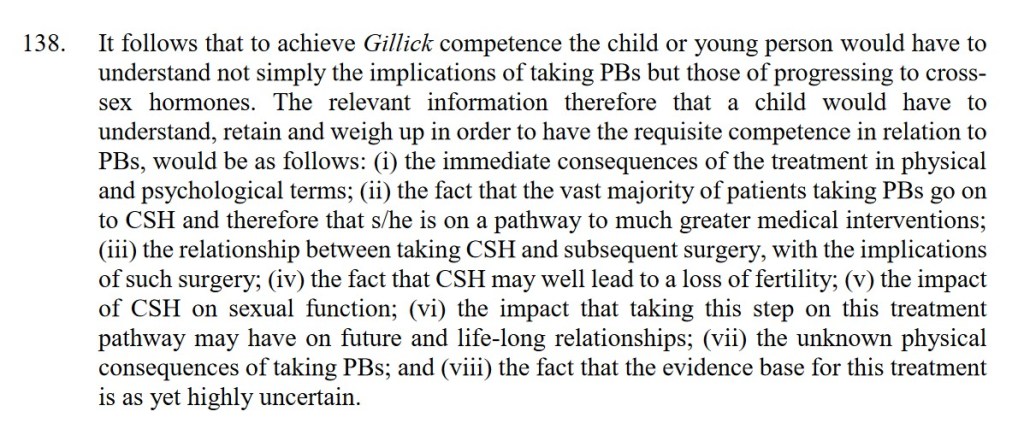
The list of factors that the Court believes a young person needs to understand in order to be Gillick competent are as follows:

It is not impossible that a teenager would be able to answer to this list. However, it would be difficult to prove.

The Court’s reasoning includes the following excerpt:

“First, the clinical interventions involve significant, long-term and, in part, potentially irreversible long-term physical, and psychological consequences for young persons. The treatment involved is truly life changing, going as it does to the very heart of an individual’s identity. Secondly, at present, it is right to call the treatment experimental or innovative in the sense that there are currently limited studies/evidence of the efficacy or long-term effects of the treatment. (148)

… In principle, a young person’s autonomy should be protected and supported; however, it is the role of the court to protect children, and particularly a vulnerable child’s best interests. The decisions in respect of PBs have lifelong and life-changing consequences for the children. Apart perhaps from life-saving treatment, there will be no more profound medical decisions for children than whether to start on this treatment pathway. In those circumstances we consider that it is appropriate that the court should determine whether it is in the child’s best interests to take PBs. There is a real benefit in the court, almost certainly with a child’s guardian appointed, having oversight over the decision… As we have explained above, we consider this treatment to be one where the protective role of the court is appropriate… (149)

The problem is not the information given, but the ability of the children and young people, to understand and most importantly weigh up that information. The approach of the defendant appears to have been to work on the assumption that if they give enough information and discuss it sufficiently often with the children, they will be able to achieve Gillick competency. As we have explained above, we do not think that this assumption is correct.” (150)

There are likely to be a number of effects arising from this decision. In this section, I am expressing my own opinions.

Firstly, it is likely to cause a significant chilling effect on the prescription of gender-affirming hormonal treatments to persons under 16. The Court appears to use a reasonable-person standard that it is holding high above the heads of children (whether or not, in real life, they could meet it). With this, it will be harder for a child to be declared Gillick competent to receive puberty blockers. The “protective” role of the Courts is also a concern. Will court orders be required in the provision of puberty blockers to young trans people? This would cause significant delays in treatment and could potentially have deleterious effects on the mental health of the young people in question, both from the delay and the general difficulties of going through the scrutiny and stress of the court process.

(Edit, 9pm, December 1st: it is being reported that the GIDS is already contacting families of trans young people and cancelling their appointments.)

Even for a decision regarding medical treatments, this is a particularly pathologised piece of jurisprudence. This blog post has tried to be trans-affirming in its expressions; however, in that, it does not follow the judgment itself. Transgender identity is referred to as ‘gender dysphoria’ all through, with the emphasis on its diagnosis as a psychological condition that people “suffer from.” There is no affirmation of the identities of these young people and no rights-based language. Transition is presented as a negative process which should almost be avoided if possible, rather than a series of interventions, many reversible, which can improve the lives of the people in question.

With regard to the correlation between children who take puberty blockers and adults who go on to take hormonal interventions, the Court seems to take the high correlation rate as an indicator that such advancement is inevitable, even including the effects of “CSH” on sexual function (etc) in their conditions for Gillick competence. This seems erroneous. Correlation is not destiny. Puberty blockers are reversible. Adult hormonal treatments are not inevitable. It does not seem entirely justifiable to say that one MUST understand the effects of adult hormonal treatments at age 13 when one must be at least 16 to make the informed choice as to whether to begin those treatments.

Lastly, and most concerningly, this case may have ripple effects for other questions of the bodily autonomy of minors. What happens now to a 14-year-old presenting needing an abortion? Is she to be taken to understand the “lifelong consequences” of her decision, or is the standard for Gillick competence to be raised on her too? If so, there is a human rights violation in the waiting for minors needing reproductive healthcare and it seems inevitable that this will end up before the Courts.

Dr Sandra Duffy holds a PhD in international human rights law, focusing on gender identities and gender recognition law. She is co-author of the ILGA Trans Legal Mapping Report, which catalogues global gender recognition laws.