a change is gonna come: reflections on the Repeal campaign

i. today was just the day when all the numbers changed

When it’s all over, really, I’m by myself. At home – “home” home, not home base – in my parents’ house, not long off the late train from Galway. I’d voted in Galway that morning. On the way, nervous, quickly divesting myself of Yes and Lawyers for Choice paraphernalia, I’d wondered if I’d cry. I didn’t. I couldn’t stop smiling.

I’m not sure where the rest of the day went; next thing I know, I’m sat in my childhood bedroom and it’s 9.50pm. The exit polls are about to be released. I’m thinking we have it, but maybe by a margin of about 3%. 55%, if we’re lucky; 58%, if I let my imagination run away with me.

By the time the figures are announced on the Late Late Show, they’ve been online for several minutes. My mother calls me, have you seen? 69.4%!

I can’t speak. I genuinely can’t form words.


ii. the notion of a nation we now get to build

The words I have poured into this campaign, though. Sometimes I feel as if I’ve used up several years’ worth of words in one go. It’s been a river of language, a vast storm system of the stuff. Drunk with words, laden with meanings, I look up from my screen and feel at once smaller than I ever have and yet connected to a web of women all sending our thoughts into the ether, searching for someone to say yes, yes, I hear you, you are real. Your thoughts are valid.

I imbue words with a particular weight because semantics is the lawyer’s playing field of choice. We love words. We love reading things in context, and contemporaneously, and in the light of prevailing ideas and concepts. What, then, is 2018? 2018 is the year that the people of Ireland decided that the words in the foundational document of our country were not fit for purpose; that read in the light of the twenty-first century, Article 40.3.3 of the Constitution was a national embarrassment and deserved to be consigned to the history books.

Ireland’s legal system is founded on the principle of Constitutional supremacy: there is no law higher than the Constitution and it cannot be overturned. What is written in that text therefore forms the mainframe of Irish law. On the campaign trail, I often used the analogy of a house: within the house, you can decorate in whatever way you wish, but if the roof is eight feet tall, you can’t fit a ten-foot Christmas tree into it.

Like all created things, Ireland is, at its core, a story. Our modern narrative was born in revolution and forged out of the fellowship of rebels of all genders who campaigned for independence through repression and war. The 1916 Proclamation of Independence and the 1922 Irish Free State Constitution explicitly recognise the rights and contributions of Irishmen and Irishwomen. However, by the time the 1937 Constitution was written, the spirit of the times had changed and the narrative of glorious Celtic mythicism and storied heroes found itself twisted to meet the needs of a conservative government and a rising Catholic church. Women were relegated to a ‘special status’; it was made clear that the subject of Irish law had a gender, and that gender was male. With every new repression – illegality of contraception, legality of marital rape, mandatory retirement from the public sector at marriage – it became more evident that the women of Ireland were second class citizens, confined to our bodies and by our bodies. By the time of the passage of the Eighth Amendment, even those bodies were no longer our own.


iii. the second job of citizenry

But another narrative runs through the blood and the brains of Irish women, a lineage that calls back to the days of Queen Maebh and Brigid of Kildare; the spirit of Constance Markievicz’ exhortation to leave their jewels in the bank and buy boots and a revolver. Irish women were ready, and when the call came, they rose.

I felt it, the electricity in the air at the Marches for Choice in Dublin city centre. I felt it while addressing a lecture hall full of students in Cork and in every smile exchanged with a fellow Repeal jumper wearer, the secret flicker of the eye to the Yes badge on my lapel and the nod: she’s in. You’re in. We’re in.

Most of all, I felt it all the time I got to spend with my fellow Lawyers for Choice, an organised chaos of academics, solicitors, and barristers; comrades and heroes one and all. Working off the clock, distracted from our Real Jobs by this volunteer group that was suddenly our Very Real Job, travelling and writing late into the night, we ran on caffeine and adrenaline right to the wire. It’s difficult to describe the kind of camaraderie you develop in a tight-knit group under extreme pressure, but there are thousands of people around Ireland who’ll understand because their canvassing or advocacy or friendship groups became the focal point of their lives for several months in the spring of 2018. They’ll tell you that they get it. They’ll tell you that you had to be there.


iv. the thanks I get is to take all this shit for you

Vignette: I am standing in the sun in Tuam, Co. Galway. It is the last weekend of the campaign. I am wearing a Lawyers for Choice badge and a t-shirt which will ill-advisedly add to the campaign sunburn I can still see in certain lights. I am standing in the sunlight at a crossroads holding my leaflets and wearing my particular campaign smile.

There is a young man standing about a foot from me, bellowing in my face.

He is telling me that I am a failure of an academic because he disapproves of our not footnoting our plain-English explanatory leaflet.

It takes me a lot longer than it should to walk away.


v. come senators, congressmen, please heed the call

I get to experience – no, that’s not enough. I get to live inside the campaign discourse in a very particular way. I have a secret identity.

In early 2016 Ruth asks me if I’d like to take care of the Lawyers for Choice twitter feed. I’m a beginning PhD student and I’ve only been in the group a few months; I am both thrilled and a little intimidated, but I start and it’s brilliant.

I sometimes experience a certain amount of (hopefully) affectionate fun-poking for my internet life, but I can’t deny it – Twitter is a medium I instinctively get. Twitter is democratic and viral. It can be as impactful as you make it. Twitter allows for banter and photo sharing and friendship formation, but where I see the most potential is as a medium for education. I love to teach, love to see students grasping principles and learning the subtle logic of the law. But law isn’t just for classrooms and courtrooms; law is made by the people and in turn it shapes us. And law like the Eighth Amendment is something people feel, before they have the words for it. For or against, abortion law is visceral. It forces us to confront our feelings about the deepest parts of ourselves; makes us think about stresses and breaking points: of our relationships and our families and our bodies.

The challenge, then, is to engage and inform without taking away from, or distancing people from, this instinctive interest. So I settle in. I crack jokes, I do layman’s terms threads, I answer questions. I discover that there is no underestimating the lack of knowledge amid the public about the Constitution and the legal system. (Over the past few years, in my head, I’ve rewritten about five separate CSPE curriculums for schools.) But the lack of knowledge doesn’t imply either a lack of interest or a lack of ability – in fact, the @LfC followers are engaged and acute and very quickly law-literate. We do Irish law and international law; we talk about the European Court of Human Rights and the United Nations. When the Mellet and Whelan decisions come down from the UN Human Rights Committee, we go through the findings and point out the standards Ireland is breaching. We do more or less a Fundamentals of the Irish Legal System course over the months – separation of powers, legislative process, hierarchy of laws, our interactions with the international bodies, fundamental rights in the Constitution. And we do it all with humour, with gifs, with frequent requests that people send us dog pictures.

And then the deliberative process begins for real around the potential for a referendum and law reform, and out of some misguided and possibly masochistic whim, we decide to livetweet it – partially as note-taking, partially as communication. What we do not expect is that it becomes a virtual meeting-place, news studio, and lecture hall all at once. The Citizens’ Assembly, the Joint Oireachtas Committee on the 8th Amendment, and the Oireachtas deliberations, via the medium of twitter, become a feature of our lives and our followers’ weeks. What this means in practice is that I (most often – or Máiréad, or Ruth, or Gearóidín) spend a lot of time sitting on my sofa, hopped up on espresso, sometimes loudly cursing into the empty room, and typing until my hands beg me to let them fall off. I become familiar with TDs of whom – with apologies – I’ve never heard. I become familiar with procedural rules about which I do not care, still. I learn the hard way that trying to keep up with certain Senators once they’re off on one is a fool’s errand. I invent the Mullen Stream of Consciousness style of tweet.

All through it, in another tab, our notifications stream is updating too fast for my browser to handle. People laughing, people asking questions and for clarifications, people bemoaning their bad luck in being represented by these luadhramáns. Kerry, Tipperary, Louth, and the entire alumni population of NUI are loudest among those. We listen to the testimonies of experts before the JOC and talk through their facts, point to sources when we find them. We sit in collective tears as the representatives of Terminations for Medical Reasons discuss their harrowing experiences seeking abortion in England. We fact-check claims and call out bogus remarks. Some Senators and TDs are following along. It’s a little thrilling to interact.

Under the handle of LfC, a nebulous dispenser of sarcasm and information, I am braver and brasher than I can ever be as me. People respond to me/us/it – I raise a crisis alert one day because I have run out of biscuits. People offer to send me biscuits. I love twitter more each week.

It’s not easy. It’s frustrating, time-consuming, saddening. By the end of a Committee session I am exhausted from the flow of information, the speed of the interactions, and the heavy weight of a lot of the testimonies. They talk about women dying, about losing wanted pregnancies, about trying to quantify risks to pregnant people’s health. They try to quantify how suicidal is suicidal enough, how close to the brink of sepsis and death can you let a person go before you allow her a termination. I want to throw my laptop out the window. They talk about how there isn’t that much child abuse happening in Ireland. I swear to myself I’ll never go on the internet again. They announce an extra sitting the next day. I sigh and promise twitter I’ll be there.

From the livetweeting I develop a new sense of the relationship between population and law, something which deepens my theoretical understanding of the field as well as making me a better educator. I learn to simplify concepts into 280 characters while getting the information across accurately. I make friends, too. @LfC establishes an ongoing banter with some of our fellow professional groups, something which strengthens us as a campaign. I hope we contribute in some part toward the number of people who say human rights law was one of their reasons for voting Yes. And it’s good craic.

I seriously do consider defenestrating my laptop during some McGrath monologues. But I wouldn’t swap the job. It’s the biggest contribution I make to the campaign, @LfC social media. Sometimes it feels like my only contribution, but if that’s true, I make it count. I have to make it count.


vi. I know you’ve got a little life in you yet

I don’t look back fondly on 2018. The campaign ate up the spring to all intents and purposes, but at home I was dealing with a severe relapse of chronic health issues with all the attendant fuss and worries. I remember it mostly through a haze of exhaustion and medicated fuzziness. Days of monotone rain lashing my windows and nights of crushing panic that the referendum would fail and it would be My Fault. Or that it would pass, and I would be watching from the sidelines, too ill to work, unneeded and unnoticed. I pour all my negative feelings about myself and my illnesses into my feelings about the campaign, and I don’t notice until it’s over and I feel like crying every time someone tells me I should be proud.

I’m not the only one. Stories start coming out. Canvassers phoning home, phoning each other, in tears after being berated or disappointed. A colleague who couldn’t face speaking about Repeal again until asked to for a talk six months later. Worries about jobs, parenting, relationships. The constant weight of anti-choice rhetoric and insults and posters and being called a murderer and stony silences across dinner tables.

Picking up my PhD again and wondering who this stranger was, who wrote so eloquently on a topic entirely unrelated to repealing the bloody Eighth Amendment. Wondering how long it would take me to become her again.


vii. one day like this a year would see me right

And then there were the gorgeous, technicolour moments, and it was worth it. (Was it? Was it worth it all? It was.) Standing at a stall by the Spanish Arch in blazing sunshine while a band played Stand By Me. Laughing until I ached at the Twitter responses to our livetweets. Watching the Radical Queers and the Angels for Repeal show up in a carnival of Pride flags and Irish flags and banners to block out graphic photos held by anti-choicers. An old man leaning his head in close, inviting confidences, and saying “it’s not right. You should have your choice.” A woman my parents’ age saying her vote was for her baby granddaughter’s future.

And then the day of the count, the wall of noise entering the RDS, shuffling ballots and excited campaigners and impatient reporters. Dodging cameramen and meeting Repealers I’d only known through the internet but who were already friends and giving a year’s worth of hugs in an hour. Roars of approval when campaign leaders walked in. A photo of Savita, poignantly, hanging in a corner – later hidden from view. A whole gaggle of Lawyers for Choice, dispersing and reuniting around the hall within the crowd’s Brownian motion. A moment where it’s all too much and I find myself sitting down outside the scrum, teary-eyed, until my friends come and find me again.

We’re carried to the Together for Yes reception in the flow of people – more uproar, more jubiliation, and Katie and I end up sitting on the floor of the hotel drinking white wine and wondering when this became our lives and whether it’ll ever be normal again. Later, some of the group go to Dublin Castle for the official announcement, but for a handful of us the day’s been enough already. I finish up the afternoon reclining against sofa cushions in Katie’s house, a snoring French bulldog supine in my lap, and I look up at the ceiling, and realise we made it –

and for the first time in months, I feel like I can breathe.


viii. when love became an act of defiance

January 2019. Since New Year’s Eve this post has been sitting at the edge of my consciousness much as the tab has been sitting in my browser. Every time I sit down to write my actual research notes, I can’t concentrate until I add something to this. What is it, this compulsion toward narrative? Is it the new year making me pensive or is it a need to cleanse all of this from my brain? I make only one resolution for this year – I will finish my PhD thesis. My wall planner is new, blindingly white, alternately a warning and a promise when I consider its boxes. There will be no campaigning turning my life upside down in 2019. I miss it. Theoretically.

The referendum wasn’t the end of the story, of course. The Oireachtas debates drag on for weeks and weeks, and the anti-choicers who know they’ve lost attempt to filibuster the Bill out of existence. They relitigate the same points over and over – so I livetweet the same points over and over until it’s enough and I refuse to publicise them any more. The Seanad presides over the last stage of debate. It’s filibuster city. I stay awake until 1.30am one night and they’re still talking when I fall asleep. They get up and come in the next morning anyway and do it all over again. When it finally, finally passes, I’m at the laptop and I follow the closing speeches from the pro-choice stalwarts who are seeing the culmination of decades of work. @LfC, for all her snarky bravado, is a bit misty while tweeting this (then Ivana Bacik gives us a mention in her closing speech, and @LfC sheds a full-on tear or two).

The Bill has a rake of problems; there’s nothing stopping protests at clinics yet; people from Northern Ireland will face large fees to access abortion down south. We know this, but at the same time, it’s like a heavy weight has been lifted off me. It’s not enough, but it’s so much more. We’ll fix the problems. We can work on this now, we can talk about abortion openly, we can walk people to the doctor past the protesters with our heads held high. We’re not hiding in the shadows any more.

I would like to stop thinking about abortion law for a while. I would like to stop thinking for a while, full stop. In autumn 2018 I take a leave of absence from my PhD for a few weeks. 2018 has been a heavy year. Illness, referendum, research, teaching, more referendum, dealing with the deferred grief over losing my grandmother in 2017. My brain is tired. I go home to my family and hang out with my dog; I read a lot of consequence-free mystery novels; I sit on Nimmo’s Pier in the sun on the last good Saturday of autumn.

And of course, then the Oireachtas debates start and I have to put my lawyer hat back on again. But that, I’m coming to understand, is life.
On the Constitutionality of Legislating for Fatal Foetal Abnormality Cases

This week the Dáil debates a Bill put forward by Mick Wallace TD which seeks to amend the Protection of Life During Pregnancy Act 2013 to allow for termination of pregnancy in cases of fatal foetal abnormalities. It is the same document as was proposed by Clare Daly TD, and ultimately rejected by the Dáil, in 2013. Regardless of the performance of the Bill before the Oireachtas, there is obvious need for legal commentary on the fatal foetal abnormalities and the Constitutionality of legislating to allow for abortion in such cases.

Fatal foetal abnormalities, or FFAs, are conditions so detrimental to the growth of a foetus that it will never reach term, or never survive outside of the womb. It is crucial that the distinction is made between FFAs, which are sometimes termed conditions ‘incompatible with life’, and conditions which cause disabilities but do not prevent a baby being born and surviving outside the womb. Much emotive language is used in the debate on this issue, and that distinction becomes lost; this Bill, and this commentary, deals only with cases of FFA. Equally, it is important in all circumstances to challenge the assertion that this Bill requires, recommends, or enforces abortion procedures on persons whose pregnancy has received a diagnosis of FFA. The aim of the Bill is to provide the possibility of a legal choice to terminate for these persons within the Irish jurisdiction.

The Government and some members of the Opposition are currently intending to vote against the Bill due to advice from the Attorney General that it is unconstitutional. This was the reason for the original Bill’s failure in 2013. However, it is not the place of the Attorney General, the Government, or indeed any other party to decide whether a piece of legislation is unconstitutional – that is the exclusive prerogative of the Supreme Court under Article 26 of the Constitution. This commentary provides an overview of the law in the area and backing for the argument that the Bill may in fact be Constitutionally legitimate.

The Protection of Life During Pregnancy (Amendment) (Fatal Foetal Abnormalities) Bill 2013 (The Bill/The FFA Bill)

The wording used by the Bill is as follows:

“‘fatal foetal abnormality’ means a medical condition suffered by a foetus such that it
is incompatible with life outside the womb;”


and


“(1) It shall be lawful to carry out a medical procedure in respect of a pregnant woman in accordance with this section in the course of which, or as a result of which, a pregnancy is ended, where
(a) the medical procedure is carried out by an obstetrician at an appropriate institution, and
(b) subject to section 19, two medical practitioners, having examined the pregnant woman, have jointly certified in good faith that the foetus in question is suffering from a fatal foetal abnormality.”


These provisions would be inserted into the Protection of Life During Pregnancy Act 2013.


The Current Law


Currently, abortion is regulated under two sources of law in Ireland: the Eighth Amendment to the Constitution, and (in a subsidiary manner) the PLDPA 2013.


The Eighth Amendment, Art. 40.3.3 of the Constitution, provides that:


 “The State acknowledges the right to life of the unborn and, with due regard to the equal right to life of the mother, guarantees in its laws to respect, and, as far as practicable, by its laws to defend and vindicate that right.”


While the PLDPA 2013 allows for abortion in cases where:


– there is risk to the woman’s life from physical illness; this must be certified by two doctors, one of whom must be an obstetrician (PLDPA 2013, s7);
– there is risk to the woman’s life in a critical/emergency situation (PLDPA 2013, s8);
– there is risk to the woman’s life from suicide; this must be certified by three doctors, of which there must be an obstetrician and two psychiatrists, one of whom must be a HSE practitioner (PLDPA 2013 s9).


In the case of Attorney General v X, in 1992 (X or the X case), it was held by the Supreme Court that it was constitutionally legitimate to allow an abortion to be carried out in cases where there is a real and substantial risk to the life of the mother. The judgment in X is constitutionally significant both in reasserting the power and duty of the Supreme Court in deciding on the legitimacy of interpretations of the Constitution, and opening the possibility of legislating under Art. 40.3.3.


The X judgment draws its principles from the foundational jurisprudence of personal rights under Irish law. Finlay CJ, speaking for the majority, opens his consideration of the interpretation of Art. 40.3.3 by referring to the case of McGee v Attorney General (1974), wherein it is stated that


In this country, it falls finally upon the judges to interpret the Constitution and in doing so to determine, where necessary, the rights which are superior or antecedent to positive law or which are imprescriptible or inalienable… According to the preamble, the people gave themselves the Constitution to promote the common good, with due observance of prudence, justice and charity so that the dignity and freedom of the individual might be assured. The judges must, therefore, as best they can from their training and their experience interpret these rights in accordance with their ideas of prudence, justice and charity. It is but natural that from time to time the prevailing ideas of these virtues may be conditioned by the passage of time; no interpretation of the Constitution is intended to be final for all time. It is given in the light of prevailing ideas and concepts. [emphasis added]

He also quotes O’Higgins CJ in The State (Healy) v Donoghue (1976), in saying that:

The preamble envisages a Constitution which can absorb or be adapted to such changes. In other words, the Constitution did not seek to impose for all time the ideas prevalent or accepted with regard to these virtues at the time of its enactment.

There is, therefore, constitutional backing and jurisprudential precedent for the power of the Supreme Court to decide on the legitimacy of interpretation of the Constitution’s provisions, including the personal rights envisioned in Art. 40.3.

With regard to the making of legislation, the opinion of McCarthy J (concurring) in X states that the need visible in the Eighth Amendment for a determination of the level of risk to woman and foetus involves (paragraph 143)

the recognition that the wording of the Amendment contemplates abortion lawfully taking place within this State.

Therefore there exists the possibility of legislating for cases in which an abortion could be permitted under the Eighth Amendment. McCarthy J goes on to state that (paragraphs 146-148)

I agree with the Chief Justice that the want of legislation pursuant to the amendment does not in any way inhibit the courts from exercising a function to vindicate and defend the right to life of the unborn. I think it reasonable, however, to hold that the People when enacting the Amendment were entitled to believe that legislation would be introduced so as to regulate the manner in which the right to life of the unborn and the right to life of the mother could be reconciled.

In the context of the eight years that have passed since the Amendment was adopted and the two years since Grogan’s case the failure by the legislature to enact the appropriate legislation is no longer just unfortunate; it is inexcusable. What are pregnant women to do? What are the parents of a pregnant girl under age to do? What are the medical profession to do? They have no guidelines save what may be gleaned from the judgments in this case. What additional considerations are there? Is the victim of rape, statutory or otherwise, or the victim of incest, finding herself pregnant, to be assessed in a manner different from others? The Amendment, born of public disquiet, historically divisive of our people, guaranteeing in its laws to respect and by its laws to defend the right to life of the unborn, remains bare of legislative direction. Does the right to bodily integrity, identified in Ryan v. Attorney General [1965] I.R. 294 and adverted to by Walsh J. in S.P.U.C. v. Grogan [1989] I.R. 753 at p. 767, involve the right to control one’s own body?…

Since the Amendment contemplates lawful abortion, how may the State still, as far as practicable, vindicate the right to life of the unborn? Legislation may be both negative and positive: negative, in prohibiting absolutely or at a given time, or without meeting stringent tests: positive by requiring positive action. The State may fulfil its role by providing necessary agencies to help, to counsel, to encourage, to comfort, to plan for the pregnant woman, the pregnant girl or her family. It is not for the courts to programme society; that is partly, at least, the role of the legislature. The courts are not equipped to regulate these procedures.
[emphasis added]

Despite this judicial criticism, it would be 21 years before the Oireachtas would finally legislate for X in the PLDPA 2013. An open-ended provision such as the Eighth Amendment instils a duty to legislate in order that the rule of law be open, certain, accessible, and non-arbitrary. It cannot be practicable for every case to go through a full hearing to Supreme Court level in order to ascertain the constitutionality of the actions and circumstances involved therein. Legislation is needed, and the Supreme Court itself recognised this nearly 25 years ago.

The Potential for Legislation for FFA Cases

Having established that there are circumstances in which the “right to life of the unborn” and the “right to life of the [pregnant woman]” can be weighed in such a manner as to legally allow for a termination in this jurisdiction, the question arises as to whether there are other situations wherein a similar determination could be made. It is proposed that a diagnosis of fatal foetal abnormality is such an instance.

In X, McCarthy J states that (paragraph 140)

The right of the girl here is a right to a life in being; the right of the unborn is to a life contingent; contingent on survival in the womb until successful delivery.

If the unborn has developmental abnormalities to such an extent that it is the opinion of medical experts that it is not viable for survival outside the womb, can it be argued that it does not in fact have an “equal right to life”, as it will in all likelihood never achieve such a life?

In the European Court of Human Rights case of D v Ireland (2006), an Irish woman who was forced to travel to the UK for a termination of her pregnancy following the loss of one of the twins she was carrying, and a diagnosis of fatal foetal abnormality in the other, she was carrying alleged breaches by the Irish government of her ECHR rights under Articles 3, 8, and 10 (the rights to freedom from cruel, inhuman, and degrading treatment; respect for private and family life;, and freedom of expression and information, respectively). In the event, it was found that D had not exhausted domestic remedies, thereby rendering her ECHR challenge inadmissible. However, in their submissions supporting the assertion of non-exhaustion of domestic remedies, the Irish government itself put forward the following argument (paragraph 72):

it was an open question as to whether Article 40.3.3 could have allowed a lawful abortion in Ireland in the applicant’s circumstances. The X case demonstrated the potential for judicial development in this area and, further, the X case did not exclude possible evolution in cases such as the applicant’s: the foetus was viable in the X case whereas in the present case there might be an issue as to the extent to which the State was required to guarantee the right to life of a foetus which suffered from a lethal genetic abnormality. The meaning of “unborn” in Article 40.3.3 had attracted some public and academic comment… However, there had been little judicial examination of the meaning of “unborn” and certainly no case comparable to the present. Accordingly, although it was true that Article 40.3.3 had to be understood as excluding a liberal abortion regime, the courts were nonetheless unlikely to interpret the provision with remorseless logic particularly when the facts were exceptional. If therefore it had been established that there was no realistic prospect of the foetus being born alive, then there was “at least a tenable” argument which would be seriously considered by the domestic courts to the effect that the foetus was not an “unborn” for the purposes of Article 40.3.3 or that, even if it was an “unborn”, its right to life was not actually engaged as it had no prospect of life outside the womb. In the absence of a domestic decision, it was impossible to foresee that Article 40.3.3 clearly excluded an abortion in the applicant’s situation in Ireland.
[emphasis added]

This is precisely the argument which could be made for allowing the passage of the FFA Bill. If passed, the Bill would be referred to the President for his signature; if the President finds that there is a potential Constitutional issue with a Bill, he has the power under Article 26 of the Constitution to refer it to the Supreme Court for their examination and approval or otherwise.

If the Government truly believe in the Supreme Court’s role as arbiter of the constitutionality of legislation, they should not allow themselves be blocked from passing a Bill on the basis of legal advice that the law in question might be found to be unconstitutional. The Attorney General, although the Government’s lawyer, does not have the power to determine constitutionality; only to advise. The only way to know if this Bill is legitimate under Article 40.3.3 is to pass it and allow the Supreme Court to examine it – all else is speculation.

Notes:
I use ‘woman’ in this commentary when speaking about people who have the capacity to become pregnant; this is not to erase the fact that transgender men and non-binary identifying persons can also, of course, be pregnant.


While drafting this post I found this letter to the Irish Times by fellow Lawyers for Choice members and colleagues (including both of my PhD supervisors). This was not only excellent reassurance that I was on the right track, but proof that this argument is not new and that the Government has been under advisory of it for years even as they continue to duck the question of legislating for FFA. To use McCarthy J’s wording, their failure to act is “no longer just unfortunate – it is inexcusable.”

Letter to the Irish Examiner, 30th June 2016

I submitted this to the online letters page of the Irish Examiner this afternoon, in response to an op-ed piece which contained a series of factual and legal inaccuracies. I am not sure if it will be published, yet, but it’s worth archiving here.


Dear Editor,

I write in response to Margaret Hickey’s article of 30th June. Ms Hickey makes some claims about the Protection of Life During Pregnancy (Amendment) (Fatal Foetal Abnormalities) Bill under debate in the Dáil with which I disagree.

a) Ms. Hickey’s claim that “fatal foetal abnormality” is not a legitimate term is unfounded. It is widely recognised by medical and legal authorities that this definition refers to a foetus which will not reach term, or a baby which will not survive outside the womb. Termination of such pregnancies has been recognised by doctors including Masters of the Holles Street and Rotunda Hospitals, Rhona Mahony and Fergal Malone, as a medical need and the compassionate choice for families undergoing this trauma.

b) Fatal foetal abnormality is not a term interchangeable with disability. It is also illogical and unfounded to relate legislation for abortion to legislation for euthanasia.

c) Ms Hickey states without grounding that the Wallace Bill is unconstitutional. With due respect to her and to the reported legal advice of the Attorney General to Government, the only entity which can make this designation is the Supreme Court. The Irish Supreme Court has never heard proceedings on this ground. Article 40.3.3 speaks of the “right to life of the unborn”; it is for the Supreme Court to decide if a Bill regarding foetuses which will never have life outside of the womb falls within this provision, as the Irish Government itself submitted in the European Court of Human Rights case D v Ireland. It would be legitimate within the wording of the provision for the Supreme Court to consider this Bill Constitutional.

d) Passing the Fatal Foetal Abnormalities Bill would not negate the need for a repeal of the Eighth Amendment. Rather, it would give relief to some families in traumatic circumstances while the country continues to debate a full repeal and the ensuing legislative possibilities.

e) The United Nations Human Rights Committee case of AM v Ireland has recently found that Ireland’s refusal to terminate on the grounds of fatal foetal abnormality breached AM’s human rights to privacy, including bodily integrity; to freedom from cruel, inhuman and degrading treatment; and to freedom from discrimination. Ireland is in breach of its voluntary commitments under international human rights law. It is unconscionable that we allow this situation continue.

Is mise le meas,

Sandra Duffy,

PhD candidate in human rights law, UCC.

Taking a Stand – reproductive rights in conflict with law

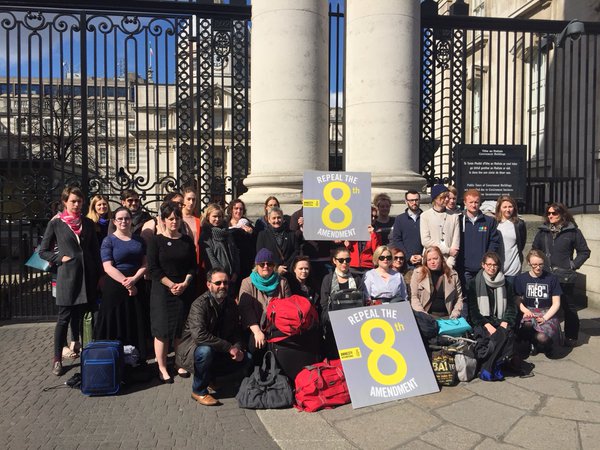
This afternoon I was fortunate enough to be in Dublin to attend the third day of Amnesty Ireland’s two-week campaign to repeal the Eighth Amendment. Each day for fourteen days they plan to have a presence on Merrion Street, outside Government Buildings; each day twelve more people will add to their numbers, to represent the twelve people forced, each day, to travel to the UK to access a legal abortion.

The simple force of this this protest is visible in the photos taken each day – three, so far – the numbers swelling and the corresponding pile of baggage getting higher. There is something deeply resonant in the action of placing oneself physically in a particular space to represent someone whose physical agency has been removed from them.

Discussion of physicality and embodiment are central to the work of gender and sexuality law. As much as current – and correct – thought trends toward removing the medical and physically-based definitions of queer identities (and I am using ‘queer’ in the sense of non-normative, challenging), the issue remains that the body is the site of conflict with the law when such conflict arises. The law meets these challenging identities in the regulation of gender identity and expression; the freedom to have sex, marry, form a family; and, in the instant case, the decision to regulate pregnancy status.

Asserting these freedoms brings the individual into contact with the regulatory power of the law, in their very corporeal existence. It is probably not the foremost thought in most people’s minds as they book a ferry ticket and try to think of an excuse for needing two days off work, but the conflict between the individual and the institutions of governmentality is playing out in their physical person as they do so.

Writing on transsexuality, Judith Butler interrogates our use of the phrase ‘doing justice to [someone]’. While her paper centres around gender identity regarding intersex children and non-consensual medical intervention, her critical examination of the space in which law and society allow individuals to exist is worth noting:

This is what Foucault describes as the politics of truth, a politics that pertains to those relations of power that circumscribe in advance what will and will not count as truth, that order the world in certain regular and regulatable ways, and that we come to accept as the given field of knowledge. We can understand the salience of this point when we begin to ask: What counts as a person? What counts as a coherent gender? What qualifies as a citizen? Whose world is legitimated as real? Subjectively, we ask: Who can I become in such a world where the meanings and limits of the subject are set out in advance for me? By what norms am I constrained as I begin to ask what I may become? What happens when I begin to become that for which there is no place in the given regime of truth? This is what Foucault describes as “the desubjugation of the subject in the play of… the politics of truth.”

Another way of putting this is the following: What, given the contemporary order of being, can I be?

When we interfere to the core of people in their most vulnerable moments, we are doing (in)justice unto them. The pregnant person does not get to decide if they wish to buy into the justice system of the state; they are merely the object of its dictats. They do not get to challenge the system in which they live; their survival needs render them extra-legal. Can one ever feel like a legitimate citizen when the regulatory power of the state has reached into the very blood and marrow of them and declared their physical needs non-normative and their mental wishes deviant?

But as noted, this is not the primary concern of the person in crisis, if indeed it is a concern at all. Into this space, then, step pro-choice activists. While it could be said that Irish women and AFAB people are always potential sites of conflict with reproductive rights law, not being currently in crisis offers the opportunity to stand in place of those who are.

Máiréad Enright wrote last year of the position of pro-choice activists in political discourse, using Rancière’s distinction between police and politics. She relates this to the importance of the presence of outsider voices and representation as a challenge to the status quo:

True politics, by contrast, is about upsetting the dominant distribution of the sensible. Politics takes place when in moments of dissent “the part of no part” – those who normally should not be seen or heard – intervene in the established system of meanings, questioning it, and by that questioning insisting on their equality with others as political subjects and members of a broader “we”. For example, at this year’s March for Choice, the comedian Tara Flynn spoke movingly about Ireland’s abortion regime. In a lighter moment, she noted that reproductive rights campaigns were often construed in the public sphere as a ‘women-y fringe-y thing”. But, she said, of the assembled pro-choice marchers, “we are not some women-y fringe-y part of society, we are society”.

We are society. We are political, we are visible, and we are choosing to use our physical autonomy in the defence of those who are denied theirs. Creating this community, this space wherein we act to queer the strictures of the Irish legal system’s understanding of gender roles, resonates far beyond the hour spent at Government Buildings. It is a rebellion, a deliberate step into transgressive territory. When physical oppression is enacted, physical challenge is the only freedom left us. We’re using it.

I’ll be back on Merrion Street next week. Amnesty will be there all this week and next. Twelve people a day, tomorrow and tomorrow and tomorrow. Be their advocate. Sign up here, particularly for the latter days when 100+ people will be required: https://www.amnesty.ie/news/demonstration-outside-government-buildings-show-abortion-cannot-be-ignored-government-formation

ce4gl-kwiaevs9i
Image from @AmnestyIreland twitter (I am third from left).