Your life is not your own – R v Foster and the criminalisation of abortion

I write this post in the wake of the sentencing of Carla Foster, a British woman in her own right and mother of three, to 28 months’ imprisonment for inducing an abortion later than the legal gestational limit.

It is clear even through the unsympathetic tone of the sentencing remarks that Foster was desperate. In the middle of the strictest lockdown, when access to medical services was rare and difficult for non-COVID, non-emergent situations, she became pregnant for the fourth time, and panicked. The judge highlights her internet searches, increasingly stressed. The clock ticked. The legal limit of 24 weeks approached. Foster kept asking questions. “”[H]ow to hide a pregnancy bump”, “how to have an abortion without going to the doctor” and “how to lose a baby at six months”.” No-one was there to answer. She was living with her estranged partner and pregnant by another man. She was alone with the internet and the internet told her what to do.

In her frantic state, she phoned BPAS and lied about her pregnancy. She obtained abortifacient medication, mifepristone and misoprostol. She took the meds and miscarried – a stillbirth. She named the baby Lily. She lied again to the paramedics and midwife. Then she realised she needed to talk to the police. Now she is in prison.

I am horrified by this case and by its ramifications. Foster has three living children, one of whom has special needs. She will serve at least fourteen months. Those children are without one of their parents for over a year. The intimate details of a woman’s life are scattered across the world on the global news. Private medical decisions and personal anguish broadcast. Desperation, punished.

What I am most haunted by, though, is the surveillance of Foster’s internet searches. The internet can be a refuge or a last resort. When Foster asked Google how to abort a pregnancy at an advanced stage, one imagines that it was because she had no-one else to ask. She seemed to realise the gravity of her situation and the potential illegality of her actions. But she confided in the all-knowing internet, not in people, with an expectation of privacy and maybe a faint hope of an answer.

The law is a blunt instrument. We know this. Despite our tendency to anthropomorphise, we know that the law does not have feelings and cannot manifest compassion. The humanity of the law, if there is any, comes in its application. There was no such compassion shown here. The law stretched its tendrils into the private life of Carla Foster and exposed her to the world. The people involved in implementing the law applied it straight and true. The law is a blunt instrument.

This is not a post about the legalities of the Foster case. Nor is it a post about the morality of late abortion. This is a post about how criminalisation of a person’s intimate decisions and thoughts affects not only the person themselves, but all of us. This is a post about digital surveillance of the embodied mind. It’s about what it means to be a mind and have a body, or have a mind and be a body. It’s about autonomy and freedoms and how legal regulation closes those down like a steel trap with temporal boundaries on bodily processes. It’s about a woman, and a foetus, and the law.

Abortion is one of the most personal decisions a person can make. To allow another entity to grow inside you, or to stop that growth, is a decision taken at one’s very core. It is a decision of fullness and emptiness, obligation and freedom. The criminalisation of abortion in law is a relic of a time where women and pregnant people were not seen as having autonomy over their own embodiment. We think we are more enlightened now, and yet Carla Foster is in prison. We think we are free, and yet the law says otherwise. We think we can express our thoughts into the void of the internet, and yet the law will bring them back and lay them out for the world.

This post is a vent for feelings, really. There are half-formed thoughts in here which may make it to a paper someday. I am writing because I am sad. I am sad for Carla and her family, and I am sad for the pregnant people of Britain and Ireland and everywhere else where full decriminalisation of abortion has not happened yet. I am a lawyer, and the law feels alien to me today. I grapple with systems which I try to use for good and still I am reminded of the brute force of law on the lives of vulnerable people. And I am thinking of Carla, typing, seeking, begging.

I am sending these words out into the internet, for better or worse.

SCOTUS to overturn Roe?

Reproductive justice advocates have woken up devastated this morning at the news that SCOTUS (Supreme Court of the US) is likely to overturn Roe v Wade. Reading a draft opinion written by Justice Alito and leaked to Politico magazine, it seems that the conservative majority of the Court has at last achieved its long-standing goal of overturning the constitutional right to abortion conferred under the right to privacy in the American Constitution.

SCOTUS is the highest Court in the United States and there is no appeal against its decisions. They are settled law until a further Supreme Court modifies or overturns them. They cannot be altered by anyone else, including the government. Currently, SCOTUS has a conservative majority (thanks to the Republican administration of Donald Trump), with several justices, notably Coney Barrett J and Kavanaugh J, who are outspokenly anti-abortion.

The draft opinion, in the case of Dobbs v Jackson Women’s Health Organisation, begins by stating that “[a]bortion presents a profound moral issue.” While this is true, it has been settled law since 1973, when Roe was decided, that the constitutional right to privacy conferred a right to make decisions concerning abortion for oneself. Alito J takes a sceptical view of this from the beginning. The opinion is written from a constitutional originalist point of view, which means that it reads the US Constitution in a manner conforming to the views and outlooks of its authors. This is in contrast to a living instrument doctrine, which reads a Constitution or other legal document in terms of the present day.

Roe v Wade is a landmark case in American law. The decision that a woman or pregnant person’s 14th Amendment right to privacy conferred a right to obtain a legal abortion was momentous. However, the Roe Court also stated that the right to obtain an abortion was not absolute. In the interests of the potential life of the foetus, or the health of the pregnant person, the government of the State in question could put limits or restrictions on the right to an abortion. Many American States have done so and severely restricted the right to abortion through vexatious limitations on the ability to access the procedure. This has been challenged before the Supreme Court previously in cases like Whole Women’s Health v Hellerstedt (2013), which concerned excessive restrictions on doctors who could perform abortions in Texas. In WWH, the restrictions were struck down as being too limiting on the right to access an abortion.

Roe has been controversial from the beginning. Opposed profoundly by religious and anti-choice groups on moral grounds, its reasoning was also opposed by conservative or originalist legal commentators and legislators, who felt that Roe overstepped what could reasonably be read into the constitutional right to privacy. This is the view that Alito J takes in his draft opinion in Dobbs.

He states that “[t]he Constitution makes no reference to abortion, and no such right is implicitly protected by any constitutional provision.” (5) He believes that the right to abortion is a newly invented right which does not root in American history and is therefore not within the purview of the Court to institute via a living reading of the Fourteenth Amendment. He believes that the matter of legalising (or not legalising) abortion should be left to the legislators of each State, elected by the people. He also believes that abortion should be a special case with regard to rights, because it involves a “potential life”(32).

The removal of abortion rights from the constitutional right to privacy is not just devastating for women and pregnant people, but it is also worrying with regard to other freedoms based on cases moored in that right, such as same-sex sexual activity (Lawrence v Texas) and equal marriage (Obergefell v Hodges). Although Alito J’s opinion states that this ruling just concerns abortion and not other rights, he also says that rights based on the Fourteenth Amendment must be “deeply rooted in this Nation’s history and tradition.” (14) It is not difficult to see a future conservative SCOTUS using this logic to overturn other rights and freedoms belonging to women, LGBTQ+ people, or other vulnerable minorities.

If this is the final opinion of SCOTUS on Dobbs, it is a profound setback to reproductive freedoms in the United States. 26 American States have ‘trigger laws’ which are certain to come into action when Roe is eventually overturned (whether this is the deathblow or not, with the current make-up of the Supreme Court, it is more or less inevitable that a challenge to Roe will eventually win). For now, we wait and see when the blow will fall.

The Regulation of Termination of Pregnancies Bill 2018 – an argument for “pregnant people” wording

The July update to the General Scheme of the Regulation of Termination of Pregnancies Bill 2018 continues, in spite of commitments from Minister Harris, to be written in gendered language. This post argues that “pregnant people” should be the preferred terminology, in order to be inclusive of persons of all gender identities who will need to access abortion services.

Some short time after the commencement of the Regulation of Termination of Pregnancies Act 2018, an Irish man will attend his GP’s clinic and request an abortion. He might have in his wallet identity documents reflecting his gender, which he will have obtained under the Gender Recognition Act 2015. That Act will have affirmed that, in the eyes of the Irish law, and without the need to have undergone any surgical or hormonal intervention, our patient is male. Having certified that under one piece of Irish legislation, we could not blame him for thinking that, under other Irish statutes, he could expect not to have his gender invalidated.

The Regulation of Termination of Pregnancies Act 2018 (RTPA), if it is enacted in the current wording (updated July 2018), will invalidate his gender in a number of ways.

Firstly, if he reads the legislation governing the procedure he needs to undergo, he will find that it refers, throughout, to ‘women’. Looking at the definitions contained in the legislation, he will see that ‘woman’ is used to stand for ‘a female person of any age’.

Secondly, if his doctor is unsupportive, he may be told that he is not entitled to access termination of pregnancy. By the letter of the law, he could be told, abortions are for women.

Thirdly, if he does obtain an abortion, his doctor will have no facility to record that a trans man was the patient in question. He will be recorded with all of the other women, and ‘women’, that the Act envisions.

The question of why it is of critical importance that the RTPA be redrafted in gender-neutral language is not purely semantic. I begin this post with an imagined scenario, but it is not merely an illustrative fiction; it is a narrative with a high likelihood of coming true. Exclusionary language will impact Irish people seeking reproductive healthcare, at a time when trans people in Ireland are already finding access to trans-specific medical care slow and difficult.

Our goal in repealing the Eighth Amendment and enacting the RTPA is to broaden access to abortion care for Irish people and permit more open dialogues about reproductive health and reproductive justice within our medical, legal, and educational systems. In order to achieve this, we must refrain from excluding groups from the system ab initio. Trans persons are a small community often marginalised within societal debates, but the right to recognition of one’s gender and the right to equality before the law mean that their interests must be considered on an equal basis with those of cisgender persons.

This post uses the abbreviation ‘trans’ to signify all gender-variant persons; all those whose self-affirmed gender differs from their assignation at birth. (Conversely, ‘cisgender’ or cis describes persons whose birth assignation is congruent with their self-affirmed gender.) ‘Trans’, as opposed to ‘transgender’, allows for more scope in the range of identities addressed – both binary-identified persons, trans men and trans women, and non-binary-identified persons of differing gender identities or none at all.

Under the Irish Gender Recognition Act 2015, it is possible for a person to apply for a Gender Recognition Certificate which legally affirms their gender. The application is an administrative process, done on a basis of self-declaration with no need for medical or psychological certification. It is open to persons aged 16 years and over. At present, only binary identities can be certified. Following the receipt of a GRC, “the person’s gender shall from the date of that issue become for all purposes the preferred gender so that if the preferred gender is the male gender the person’s sex becomes that of a man, and if it is the female gender the person’s sex becomes that of a woman” (GRA 2015, s18).

It is inarguable, then, that a trans man is male in Irish law, and does not have to have undergone any medical interventions to receive that status. It follows that there are, or could be, legal men in Ireland with the capacity to become pregnant. All persons with that capacity need to be able to access the full spectrum of reproductive healthcare – including abortion.

The Regulation of Termination of Pregnancies Bill, as it currently stands, seeks to regulate the circumstances under which patients can access abortion services. The Bill envisions abortion being available from a general practitioner without restriction as to reason in the first 12 weeks of pregnancy, and subsequently for the remainder of pregnancy in circumstances of fatal foetal anomaly or serious risk to the life and/or health of the ‘woman’. As mentioned earlier, all references to the patient are framed as ‘woman/women’, and that is defined as ‘a female person of any age’.

I argue that this wording cannot be transferred to the Act as passed for several reasons. Firstly, it is wholly legally unnecessary and risks giving rise to unnecessary complications. Secondly, it risks incompatibility with the effects of the GRA and therefore infringes on the legal status of trans persons. Thirdly, it alienates this already marginalised community further from the national healthcare system.

I and others have argued that gender-neutral wording for the RTPA should be self-evident. It does not, in my view, give rise to any legal complexities – and indeed it could avert some. Gender-neutral wording, usually ‘pregnant person’, does not exclude persons of any particular gender identity. It covers both legal women and legal men, along with non-binary persons whose status is not yet covered by certification but whose gender identities should be respected by their healthcare professionals.

Neutralising the wording of the Act would also protect against situations in which a trans man could hypothetically be refused an abortion on the basis that he is not a woman and is therefore not covered. Although this may seem far-fetched, consider the range of arguments advanced by both trans-exclusionary advocates, against self-declaration, on the basis of gender essentialism, and anti-choice advocates – including doctors – around the obligation or lack thereof to refer. No person should be left facing discrimination in their access to abortion; legislators should be vigilant about leaving legal loopholes which could allow such situations to arise.

Gender recognition is a human right; this has been affirmed by the European Court of Human Rights, the Irish courts, and multiple United Nations Human Rights bodies. The ability to assert and have recognised one’s true gender identity falls under the human rights to privacy, dignity, equality, and autonomy. Ireland’s Gender Recognition Act received – and continues to receive – plaudits from the international community for its adherence to these concepts. With this in mind, upholding the legal status of trans persons as affirmed under the GRA should be a priority for the drafters of subsequent laws.

No person should be misgendered in the process of accessing legal healthcare services; ‘pregnant person’ wording ensures that misgendering both at the point of access, and in the subsequent recording of the procedure, does not happen.

The final point there is more important that it seems at first glance. Statistics are the basis on which decisions are made and successes calculated in the Health Service. Excluding trans persons from representation within those statistics effectively erases their interactions with the healthcare services from the record.

The trans community in Ireland is currently engaged in a campaign, This Is Me, to make healthcare for gender-variant persons a priority with the Department of Health. For its part, the Department has responded with a commitment to better provision of trans healthcare within the year:

“A proposed model of care for transgender children, adolescents and adults was developed last year by the HSE Quality Improvement Division, and submitted to the HSE Divisions of Primary Care, Mental Health and Acute Hospital programme,” a spokesperson for the Department of Health told Independent.ie.

“The model was developed in consultation with key treating clinicians, planners, policy makers, advocates and service users.

“This model is providing the framework for the development of National Gender Clinics and MDTs for children and adults, funded by the HSE, which will involve investment in new posts in 2018.”

The department also said they are “committed” to progressing transgender healthcare in the coming years.

“This is a concerted measure by the HSE to address the waiting times and immediate service needs of children, adolescents and adults in transition. It is envisaged that these National Teams will be in place in 2018, pending successful recruitment campaigns.”

“The HSE, across a number of programmes including mental health, acute hospitals, primary care and social inclusion, is committed to building services for this community in accordance with international best practice.”

(Independent.ie, 10 July 2018)

However, in order to continue tracking and anticipating the needs of the trans community, their interactions with the healthcare services must be visible to the Department. Forcing trans persons to misgender themselves in order to access abortions, and/or forcing doctors to report all patients as ‘women’, erases the existence of trans abortion patients from the statistics and paints a false picture of their numbers and needs.

Such are the technical arguments. The overarching principle, however, is that as a society, we need to rethink our understanding of reproductive justice. We do not have justice if we do not promote inclusion of marginalised groups, both in our philosophy and our actions. Accessibility and representation are important, and healthcare experiences should take place in an atmosphere of respect.

The conversation about fully recognising the human rights of trans persons in reproductive justice is a longer one to be written about in the future; this post is intended as a summary to address the failings in the RTP Bill. However, it would still not be right to conclude without hearing the words of a person who directly experiences these issues. As Cazembe Jackson, Black trans man and activist, wrote for WeTestify, then:

I feel like it is important to share my story because every time it is told, it normalizes trans people in the reproductive justice conversation. Often when we think of abortion access or even pregnancy and childbirth we call these “women’s issues”. This erases the experience of trans and gender nonconforming folks who also have abortions and give birth to children. It is important for for trans folks to know that they are included in this movement and that there is safe comprehensive care available for them too. I want to do everything in my power to make this a reality.

I wish that folks understood that men have abortions too.That gender is separate from the ability to reproduce children. That every person who has the ability to create children is capable of determining when if ever is the right time to do it.

We need to understand that these are not “women’s issues”. We need to start by removing trans-exclusionary language from our laws. Please advocate for Minister Harris to keep to his word, and for the revision of the wording of the Regulation of Termination of Pregnancies Bill 2018 to include the terminology “pregnant people”.
On the Constitutionality of Legislating for Fatal Foetal Abnormality Cases

This week the Dáil debates a Bill put forward by Mick Wallace TD which seeks to amend the Protection of Life During Pregnancy Act 2013 to allow for termination of pregnancy in cases of fatal foetal abnormalities. It is the same document as was proposed by Clare Daly TD, and ultimately rejected by the Dáil, in 2013. Regardless of the performance of the Bill before the Oireachtas, there is obvious need for legal commentary on the fatal foetal abnormalities and the Constitutionality of legislating to allow for abortion in such cases.

Fatal foetal abnormalities, or FFAs, are conditions so detrimental to the growth of a foetus that it will never reach term, or never survive outside of the womb. It is crucial that the distinction is made between FFAs, which are sometimes termed conditions ‘incompatible with life’, and conditions which cause disabilities but do not prevent a baby being born and surviving outside the womb. Much emotive language is used in the debate on this issue, and that distinction becomes lost; this Bill, and this commentary, deals only with cases of FFA. Equally, it is important in all circumstances to challenge the assertion that this Bill requires, recommends, or enforces abortion procedures on persons whose pregnancy has received a diagnosis of FFA. The aim of the Bill is to provide the possibility of a legal choice to terminate for these persons within the Irish jurisdiction.

The Government and some members of the Opposition are currently intending to vote against the Bill due to advice from the Attorney General that it is unconstitutional. This was the reason for the original Bill’s failure in 2013. However, it is not the place of the Attorney General, the Government, or indeed any other party to decide whether a piece of legislation is unconstitutional – that is the exclusive prerogative of the Supreme Court under Article 26 of the Constitution. This commentary provides an overview of the law in the area and backing for the argument that the Bill may in fact be Constitutionally legitimate.

The Protection of Life During Pregnancy (Amendment) (Fatal Foetal Abnormalities) Bill 2013 (The Bill/The FFA Bill)

The wording used by the Bill is as follows:

“‘fatal foetal abnormality’ means a medical condition suffered by a foetus such that it
is incompatible with life outside the womb;”


and


“(1) It shall be lawful to carry out a medical procedure in respect of a pregnant woman in accordance with this section in the course of which, or as a result of which, a pregnancy is ended, where
(a) the medical procedure is carried out by an obstetrician at an appropriate institution, and
(b) subject to section 19, two medical practitioners, having examined the pregnant woman, have jointly certified in good faith that the foetus in question is suffering from a fatal foetal abnormality.”


These provisions would be inserted into the Protection of Life During Pregnancy Act 2013.


The Current Law


Currently, abortion is regulated under two sources of law in Ireland: the Eighth Amendment to the Constitution, and (in a subsidiary manner) the PLDPA 2013.


The Eighth Amendment, Art. 40.3.3 of the Constitution, provides that:


 “The State acknowledges the right to life of the unborn and, with due regard to the equal right to life of the mother, guarantees in its laws to respect, and, as far as practicable, by its laws to defend and vindicate that right.”


While the PLDPA 2013 allows for abortion in cases where:


– there is risk to the woman’s life from physical illness; this must be certified by two doctors, one of whom must be an obstetrician (PLDPA 2013, s7);
– there is risk to the woman’s life in a critical/emergency situation (PLDPA 2013, s8);
– there is risk to the woman’s life from suicide; this must be certified by three doctors, of which there must be an obstetrician and two psychiatrists, one of whom must be a HSE practitioner (PLDPA 2013 s9).


In the case of Attorney General v X, in 1992 (X or the X case), it was held by the Supreme Court that it was constitutionally legitimate to allow an abortion to be carried out in cases where there is a real and substantial risk to the life of the mother. The judgment in X is constitutionally significant both in reasserting the power and duty of the Supreme Court in deciding on the legitimacy of interpretations of the Constitution, and opening the possibility of legislating under Art. 40.3.3.


The X judgment draws its principles from the foundational jurisprudence of personal rights under Irish law. Finlay CJ, speaking for the majority, opens his consideration of the interpretation of Art. 40.3.3 by referring to the case of McGee v Attorney General (1974), wherein it is stated that


In this country, it falls finally upon the judges to interpret the Constitution and in doing so to determine, where necessary, the rights which are superior or antecedent to positive law or which are imprescriptible or inalienable… According to the preamble, the people gave themselves the Constitution to promote the common good, with due observance of prudence, justice and charity so that the dignity and freedom of the individual might be assured. The judges must, therefore, as best they can from their training and their experience interpret these rights in accordance with their ideas of prudence, justice and charity. It is but natural that from time to time the prevailing ideas of these virtues may be conditioned by the passage of time; no interpretation of the Constitution is intended to be final for all time. It is given in the light of prevailing ideas and concepts. [emphasis added]

He also quotes O’Higgins CJ in The State (Healy) v Donoghue (1976), in saying that:

The preamble envisages a Constitution which can absorb or be adapted to such changes. In other words, the Constitution did not seek to impose for all time the ideas prevalent or accepted with regard to these virtues at the time of its enactment.

There is, therefore, constitutional backing and jurisprudential precedent for the power of the Supreme Court to decide on the legitimacy of interpretation of the Constitution’s provisions, including the personal rights envisioned in Art. 40.3.

With regard to the making of legislation, the opinion of McCarthy J (concurring) in X states that the need visible in the Eighth Amendment for a determination of the level of risk to woman and foetus involves (paragraph 143)

the recognition that the wording of the Amendment contemplates abortion lawfully taking place within this State.

Therefore there exists the possibility of legislating for cases in which an abortion could be permitted under the Eighth Amendment. McCarthy J goes on to state that (paragraphs 146-148)

I agree with the Chief Justice that the want of legislation pursuant to the amendment does not in any way inhibit the courts from exercising a function to vindicate and defend the right to life of the unborn. I think it reasonable, however, to hold that the People when enacting the Amendment were entitled to believe that legislation would be introduced so as to regulate the manner in which the right to life of the unborn and the right to life of the mother could be reconciled.

In the context of the eight years that have passed since the Amendment was adopted and the two years since Grogan’s case the failure by the legislature to enact the appropriate legislation is no longer just unfortunate; it is inexcusable. What are pregnant women to do? What are the parents of a pregnant girl under age to do? What are the medical profession to do? They have no guidelines save what may be gleaned from the judgments in this case. What additional considerations are there? Is the victim of rape, statutory or otherwise, or the victim of incest, finding herself pregnant, to be assessed in a manner different from others? The Amendment, born of public disquiet, historically divisive of our people, guaranteeing in its laws to respect and by its laws to defend the right to life of the unborn, remains bare of legislative direction. Does the right to bodily integrity, identified in Ryan v. Attorney General [1965] I.R. 294 and adverted to by Walsh J. in S.P.U.C. v. Grogan [1989] I.R. 753 at p. 767, involve the right to control one’s own body?…

Since the Amendment contemplates lawful abortion, how may the State still, as far as practicable, vindicate the right to life of the unborn? Legislation may be both negative and positive: negative, in prohibiting absolutely or at a given time, or without meeting stringent tests: positive by requiring positive action. The State may fulfil its role by providing necessary agencies to help, to counsel, to encourage, to comfort, to plan for the pregnant woman, the pregnant girl or her family. It is not for the courts to programme society; that is partly, at least, the role of the legislature. The courts are not equipped to regulate these procedures.
[emphasis added]

Despite this judicial criticism, it would be 21 years before the Oireachtas would finally legislate for X in the PLDPA 2013. An open-ended provision such as the Eighth Amendment instils a duty to legislate in order that the rule of law be open, certain, accessible, and non-arbitrary. It cannot be practicable for every case to go through a full hearing to Supreme Court level in order to ascertain the constitutionality of the actions and circumstances involved therein. Legislation is needed, and the Supreme Court itself recognised this nearly 25 years ago.

The Potential for Legislation for FFA Cases

Having established that there are circumstances in which the “right to life of the unborn” and the “right to life of the [pregnant woman]” can be weighed in such a manner as to legally allow for a termination in this jurisdiction, the question arises as to whether there are other situations wherein a similar determination could be made. It is proposed that a diagnosis of fatal foetal abnormality is such an instance.

In X, McCarthy J states that (paragraph 140)

The right of the girl here is a right to a life in being; the right of the unborn is to a life contingent; contingent on survival in the womb until successful delivery.

If the unborn has developmental abnormalities to such an extent that it is the opinion of medical experts that it is not viable for survival outside the womb, can it be argued that it does not in fact have an “equal right to life”, as it will in all likelihood never achieve such a life?

In the European Court of Human Rights case of D v Ireland (2006), an Irish woman who was forced to travel to the UK for a termination of her pregnancy following the loss of one of the twins she was carrying, and a diagnosis of fatal foetal abnormality in the other, she was carrying alleged breaches by the Irish government of her ECHR rights under Articles 3, 8, and 10 (the rights to freedom from cruel, inhuman, and degrading treatment; respect for private and family life;, and freedom of expression and information, respectively). In the event, it was found that D had not exhausted domestic remedies, thereby rendering her ECHR challenge inadmissible. However, in their submissions supporting the assertion of non-exhaustion of domestic remedies, the Irish government itself put forward the following argument (paragraph 72):

it was an open question as to whether Article 40.3.3 could have allowed a lawful abortion in Ireland in the applicant’s circumstances. The X case demonstrated the potential for judicial development in this area and, further, the X case did not exclude possible evolution in cases such as the applicant’s: the foetus was viable in the X case whereas in the present case there might be an issue as to the extent to which the State was required to guarantee the right to life of a foetus which suffered from a lethal genetic abnormality. The meaning of “unborn” in Article 40.3.3 had attracted some public and academic comment… However, there had been little judicial examination of the meaning of “unborn” and certainly no case comparable to the present. Accordingly, although it was true that Article 40.3.3 had to be understood as excluding a liberal abortion regime, the courts were nonetheless unlikely to interpret the provision with remorseless logic particularly when the facts were exceptional. If therefore it had been established that there was no realistic prospect of the foetus being born alive, then there was “at least a tenable” argument which would be seriously considered by the domestic courts to the effect that the foetus was not an “unborn” for the purposes of Article 40.3.3 or that, even if it was an “unborn”, its right to life was not actually engaged as it had no prospect of life outside the womb. In the absence of a domestic decision, it was impossible to foresee that Article 40.3.3 clearly excluded an abortion in the applicant’s situation in Ireland.
[emphasis added]

This is precisely the argument which could be made for allowing the passage of the FFA Bill. If passed, the Bill would be referred to the President for his signature; if the President finds that there is a potential Constitutional issue with a Bill, he has the power under Article 26 of the Constitution to refer it to the Supreme Court for their examination and approval or otherwise.

If the Government truly believe in the Supreme Court’s role as arbiter of the constitutionality of legislation, they should not allow themselves be blocked from passing a Bill on the basis of legal advice that the law in question might be found to be unconstitutional. The Attorney General, although the Government’s lawyer, does not have the power to determine constitutionality; only to advise. The only way to know if this Bill is legitimate under Article 40.3.3 is to pass it and allow the Supreme Court to examine it – all else is speculation.

Notes:
I use ‘woman’ in this commentary when speaking about people who have the capacity to become pregnant; this is not to erase the fact that transgender men and non-binary identifying persons can also, of course, be pregnant.


While drafting this post I found this letter to the Irish Times by fellow Lawyers for Choice members and colleagues (including both of my PhD supervisors). This was not only excellent reassurance that I was on the right track, but proof that this argument is not new and that the Government has been under advisory of it for years even as they continue to duck the question of legislating for FFA. To use McCarthy J’s wording, their failure to act is “no longer just unfortunate – it is inexcusable.”

Taking a Stand – reproductive rights in conflict with law

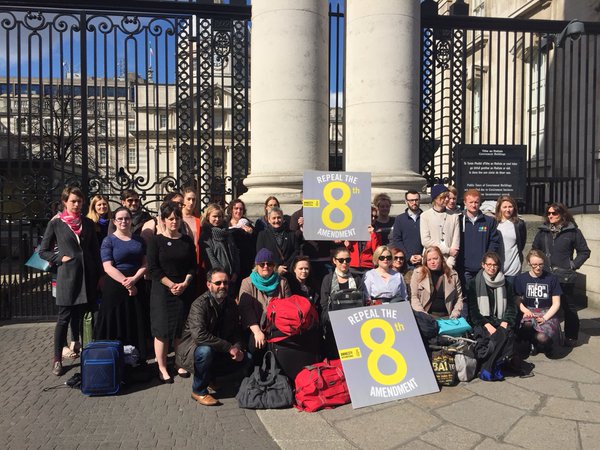
This afternoon I was fortunate enough to be in Dublin to attend the third day of Amnesty Ireland’s two-week campaign to repeal the Eighth Amendment. Each day for fourteen days they plan to have a presence on Merrion Street, outside Government Buildings; each day twelve more people will add to their numbers, to represent the twelve people forced, each day, to travel to the UK to access a legal abortion.

The simple force of this this protest is visible in the photos taken each day – three, so far – the numbers swelling and the corresponding pile of baggage getting higher. There is something deeply resonant in the action of placing oneself physically in a particular space to represent someone whose physical agency has been removed from them.

Discussion of physicality and embodiment are central to the work of gender and sexuality law. As much as current – and correct – thought trends toward removing the medical and physically-based definitions of queer identities (and I am using ‘queer’ in the sense of non-normative, challenging), the issue remains that the body is the site of conflict with the law when such conflict arises. The law meets these challenging identities in the regulation of gender identity and expression; the freedom to have sex, marry, form a family; and, in the instant case, the decision to regulate pregnancy status.

Asserting these freedoms brings the individual into contact with the regulatory power of the law, in their very corporeal existence. It is probably not the foremost thought in most people’s minds as they book a ferry ticket and try to think of an excuse for needing two days off work, but the conflict between the individual and the institutions of governmentality is playing out in their physical person as they do so.

Writing on transsexuality, Judith Butler interrogates our use of the phrase ‘doing justice to [someone]’. While her paper centres around gender identity regarding intersex children and non-consensual medical intervention, her critical examination of the space in which law and society allow individuals to exist is worth noting:

This is what Foucault describes as the politics of truth, a politics that pertains to those relations of power that circumscribe in advance what will and will not count as truth, that order the world in certain regular and regulatable ways, and that we come to accept as the given field of knowledge. We can understand the salience of this point when we begin to ask: What counts as a person? What counts as a coherent gender? What qualifies as a citizen? Whose world is legitimated as real? Subjectively, we ask: Who can I become in such a world where the meanings and limits of the subject are set out in advance for me? By what norms am I constrained as I begin to ask what I may become? What happens when I begin to become that for which there is no place in the given regime of truth? This is what Foucault describes as “the desubjugation of the subject in the play of… the politics of truth.”

Another way of putting this is the following: What, given the contemporary order of being, can I be?

When we interfere to the core of people in their most vulnerable moments, we are doing (in)justice unto them. The pregnant person does not get to decide if they wish to buy into the justice system of the state; they are merely the object of its dictats. They do not get to challenge the system in which they live; their survival needs render them extra-legal. Can one ever feel like a legitimate citizen when the regulatory power of the state has reached into the very blood and marrow of them and declared their physical needs non-normative and their mental wishes deviant?

But as noted, this is not the primary concern of the person in crisis, if indeed it is a concern at all. Into this space, then, step pro-choice activists. While it could be said that Irish women and AFAB people are always potential sites of conflict with reproductive rights law, not being currently in crisis offers the opportunity to stand in place of those who are.

Máiréad Enright wrote last year of the position of pro-choice activists in political discourse, using Rancière’s distinction between police and politics. She relates this to the importance of the presence of outsider voices and representation as a challenge to the status quo:

True politics, by contrast, is about upsetting the dominant distribution of the sensible. Politics takes place when in moments of dissent “the part of no part” – those who normally should not be seen or heard – intervene in the established system of meanings, questioning it, and by that questioning insisting on their equality with others as political subjects and members of a broader “we”. For example, at this year’s March for Choice, the comedian Tara Flynn spoke movingly about Ireland’s abortion regime. In a lighter moment, she noted that reproductive rights campaigns were often construed in the public sphere as a ‘women-y fringe-y thing”. But, she said, of the assembled pro-choice marchers, “we are not some women-y fringe-y part of society, we are society”.

We are society. We are political, we are visible, and we are choosing to use our physical autonomy in the defence of those who are denied theirs. Creating this community, this space wherein we act to queer the strictures of the Irish legal system’s understanding of gender roles, resonates far beyond the hour spent at Government Buildings. It is a rebellion, a deliberate step into transgressive territory. When physical oppression is enacted, physical challenge is the only freedom left us. We’re using it.

I’ll be back on Merrion Street next week. Amnesty will be there all this week and next. Twelve people a day, tomorrow and tomorrow and tomorrow. Be their advocate. Sign up here, particularly for the latter days when 100+ people will be required: https://www.amnesty.ie/news/demonstration-outside-government-buildings-show-abortion-cannot-be-ignored-government-formation

ce4gl-kwiaevs9i
Image from @AmnestyIreland twitter (I am third from left).