Your life is not your own – R v Foster and the criminalisation of abortion

I write this post in the wake of the sentencing of Carla Foster, a British woman in her own right and mother of three, to 28 months’ imprisonment for inducing an abortion later than the legal gestational limit.

It is clear even through the unsympathetic tone of the sentencing remarks that Foster was desperate. In the middle of the strictest lockdown, when access to medical services was rare and difficult for non-COVID, non-emergent situations, she became pregnant for the fourth time, and panicked. The judge highlights her internet searches, increasingly stressed. The clock ticked. The legal limit of 24 weeks approached. Foster kept asking questions. “”[H]ow to hide a pregnancy bump”, “how to have an abortion without going to the doctor” and “how to lose a baby at six months”.” No-one was there to answer. She was living with her estranged partner and pregnant by another man. She was alone with the internet and the internet told her what to do.

In her frantic state, she phoned BPAS and lied about her pregnancy. She obtained abortifacient medication, mifepristone and misoprostol. She took the meds and miscarried – a stillbirth. She named the baby Lily. She lied again to the paramedics and midwife. Then she realised she needed to talk to the police. Now she is in prison.

I am horrified by this case and by its ramifications. Foster has three living children, one of whom has special needs. She will serve at least fourteen months. Those children are without one of their parents for over a year. The intimate details of a woman’s life are scattered across the world on the global news. Private medical decisions and personal anguish broadcast. Desperation, punished.

What I am most haunted by, though, is the surveillance of Foster’s internet searches. The internet can be a refuge or a last resort. When Foster asked Google how to abort a pregnancy at an advanced stage, one imagines that it was because she had no-one else to ask. She seemed to realise the gravity of her situation and the potential illegality of her actions. But she confided in the all-knowing internet, not in people, with an expectation of privacy and maybe a faint hope of an answer.

The law is a blunt instrument. We know this. Despite our tendency to anthropomorphise, we know that the law does not have feelings and cannot manifest compassion. The humanity of the law, if there is any, comes in its application. There was no such compassion shown here. The law stretched its tendrils into the private life of Carla Foster and exposed her to the world. The people involved in implementing the law applied it straight and true. The law is a blunt instrument.

This is not a post about the legalities of the Foster case. Nor is it a post about the morality of late abortion. This is a post about how criminalisation of a person’s intimate decisions and thoughts affects not only the person themselves, but all of us. This is a post about digital surveillance of the embodied mind. It’s about what it means to be a mind and have a body, or have a mind and be a body. It’s about autonomy and freedoms and how legal regulation closes those down like a steel trap with temporal boundaries on bodily processes. It’s about a woman, and a foetus, and the law.

Abortion is one of the most personal decisions a person can make. To allow another entity to grow inside you, or to stop that growth, is a decision taken at one’s very core. It is a decision of fullness and emptiness, obligation and freedom. The criminalisation of abortion in law is a relic of a time where women and pregnant people were not seen as having autonomy over their own embodiment. We think we are more enlightened now, and yet Carla Foster is in prison. We think we are free, and yet the law says otherwise. We think we can express our thoughts into the void of the internet, and yet the law will bring them back and lay them out for the world.

This post is a vent for feelings, really. There are half-formed thoughts in here which may make it to a paper someday. I am writing because I am sad. I am sad for Carla and her family, and I am sad for the pregnant people of Britain and Ireland and everywhere else where full decriminalisation of abortion has not happened yet. I am a lawyer, and the law feels alien to me today. I grapple with systems which I try to use for good and still I am reminded of the brute force of law on the lives of vulnerable people. And I am thinking of Carla, typing, seeking, begging.

I am sending these words out into the internet, for better or worse.
Letter to the Irish Examiner, 30th June 2016

I submitted this to the online letters page of the Irish Examiner this afternoon, in response to an op-ed piece which contained a series of factual and legal inaccuracies. I am not sure if it will be published, yet, but it’s worth archiving here.


Dear Editor,

I write in response to Margaret Hickey’s article of 30th June. Ms Hickey makes some claims about the Protection of Life During Pregnancy (Amendment) (Fatal Foetal Abnormalities) Bill under debate in the Dáil with which I disagree.

a) Ms. Hickey’s claim that “fatal foetal abnormality” is not a legitimate term is unfounded. It is widely recognised by medical and legal authorities that this definition refers to a foetus which will not reach term, or a baby which will not survive outside the womb. Termination of such pregnancies has been recognised by doctors including Masters of the Holles Street and Rotunda Hospitals, Rhona Mahony and Fergal Malone, as a medical need and the compassionate choice for families undergoing this trauma.

b) Fatal foetal abnormality is not a term interchangeable with disability. It is also illogical and unfounded to relate legislation for abortion to legislation for euthanasia.

c) Ms Hickey states without grounding that the Wallace Bill is unconstitutional. With due respect to her and to the reported legal advice of the Attorney General to Government, the only entity which can make this designation is the Supreme Court. The Irish Supreme Court has never heard proceedings on this ground. Article 40.3.3 speaks of the “right to life of the unborn”; it is for the Supreme Court to decide if a Bill regarding foetuses which will never have life outside of the womb falls within this provision, as the Irish Government itself submitted in the European Court of Human Rights case D v Ireland. It would be legitimate within the wording of the provision for the Supreme Court to consider this Bill Constitutional.

d) Passing the Fatal Foetal Abnormalities Bill would not negate the need for a repeal of the Eighth Amendment. Rather, it would give relief to some families in traumatic circumstances while the country continues to debate a full repeal and the ensuing legislative possibilities.

e) The United Nations Human Rights Committee case of AM v Ireland has recently found that Ireland’s refusal to terminate on the grounds of fatal foetal abnormality breached AM’s human rights to privacy, including bodily integrity; to freedom from cruel, inhuman and degrading treatment; and to freedom from discrimination. Ireland is in breach of its voluntary commitments under international human rights law. It is unconscionable that we allow this situation continue.

Is mise le meas,

Sandra Duffy,

PhD candidate in human rights law, UCC.

Taking a Stand – reproductive rights in conflict with law

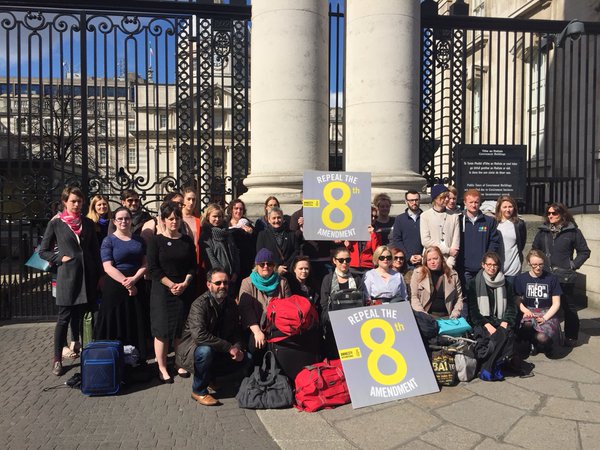
This afternoon I was fortunate enough to be in Dublin to attend the third day of Amnesty Ireland’s two-week campaign to repeal the Eighth Amendment. Each day for fourteen days they plan to have a presence on Merrion Street, outside Government Buildings; each day twelve more people will add to their numbers, to represent the twelve people forced, each day, to travel to the UK to access a legal abortion.

The simple force of this this protest is visible in the photos taken each day – three, so far – the numbers swelling and the corresponding pile of baggage getting higher. There is something deeply resonant in the action of placing oneself physically in a particular space to represent someone whose physical agency has been removed from them.

Discussion of physicality and embodiment are central to the work of gender and sexuality law. As much as current – and correct – thought trends toward removing the medical and physically-based definitions of queer identities (and I am using ‘queer’ in the sense of non-normative, challenging), the issue remains that the body is the site of conflict with the law when such conflict arises. The law meets these challenging identities in the regulation of gender identity and expression; the freedom to have sex, marry, form a family; and, in the instant case, the decision to regulate pregnancy status.

Asserting these freedoms brings the individual into contact with the regulatory power of the law, in their very corporeal existence. It is probably not the foremost thought in most people’s minds as they book a ferry ticket and try to think of an excuse for needing two days off work, but the conflict between the individual and the institutions of governmentality is playing out in their physical person as they do so.

Writing on transsexuality, Judith Butler interrogates our use of the phrase ‘doing justice to [someone]’. While her paper centres around gender identity regarding intersex children and non-consensual medical intervention, her critical examination of the space in which law and society allow individuals to exist is worth noting:

This is what Foucault describes as the politics of truth, a politics that pertains to those relations of power that circumscribe in advance what will and will not count as truth, that order the world in certain regular and regulatable ways, and that we come to accept as the given field of knowledge. We can understand the salience of this point when we begin to ask: What counts as a person? What counts as a coherent gender? What qualifies as a citizen? Whose world is legitimated as real? Subjectively, we ask: Who can I become in such a world where the meanings and limits of the subject are set out in advance for me? By what norms am I constrained as I begin to ask what I may become? What happens when I begin to become that for which there is no place in the given regime of truth? This is what Foucault describes as “the desubjugation of the subject in the play of… the politics of truth.”

Another way of putting this is the following: What, given the contemporary order of being, can I be?

When we interfere to the core of people in their most vulnerable moments, we are doing (in)justice unto them. The pregnant person does not get to decide if they wish to buy into the justice system of the state; they are merely the object of its dictats. They do not get to challenge the system in which they live; their survival needs render them extra-legal. Can one ever feel like a legitimate citizen when the regulatory power of the state has reached into the very blood and marrow of them and declared their physical needs non-normative and their mental wishes deviant?

But as noted, this is not the primary concern of the person in crisis, if indeed it is a concern at all. Into this space, then, step pro-choice activists. While it could be said that Irish women and AFAB people are always potential sites of conflict with reproductive rights law, not being currently in crisis offers the opportunity to stand in place of those who are.

Máiréad Enright wrote last year of the position of pro-choice activists in political discourse, using Rancière’s distinction between police and politics. She relates this to the importance of the presence of outsider voices and representation as a challenge to the status quo:

True politics, by contrast, is about upsetting the dominant distribution of the sensible. Politics takes place when in moments of dissent “the part of no part” – those who normally should not be seen or heard – intervene in the established system of meanings, questioning it, and by that questioning insisting on their equality with others as political subjects and members of a broader “we”. For example, at this year’s March for Choice, the comedian Tara Flynn spoke movingly about Ireland’s abortion regime. In a lighter moment, she noted that reproductive rights campaigns were often construed in the public sphere as a ‘women-y fringe-y thing”. But, she said, of the assembled pro-choice marchers, “we are not some women-y fringe-y part of society, we are society”.

We are society. We are political, we are visible, and we are choosing to use our physical autonomy in the defence of those who are denied theirs. Creating this community, this space wherein we act to queer the strictures of the Irish legal system’s understanding of gender roles, resonates far beyond the hour spent at Government Buildings. It is a rebellion, a deliberate step into transgressive territory. When physical oppression is enacted, physical challenge is the only freedom left us. We’re using it.

I’ll be back on Merrion Street next week. Amnesty will be there all this week and next. Twelve people a day, tomorrow and tomorrow and tomorrow. Be their advocate. Sign up here, particularly for the latter days when 100+ people will be required: https://www.amnesty.ie/news/demonstration-outside-government-buildings-show-abortion-cannot-be-ignored-government-formation

ce4gl-kwiaevs9i
Image from @AmnestyIreland twitter (I am third from left).